
Making money fast in open world games without cheats comes down to a handful of systems every game shares: repeatable work, one-time completion payouts, selling what you loot, delivery runs and trading. Pick the loop that matches how you like to play and the cash adds up on its own, with no trainer, console command or save editor anywhere in sight.
Updated for October 2026. A quick warning before we start: this guide is about in-game currency, the credits and dollars and marks your character earns. Playing an open world game does not pay you real money, and the sites claiming otherwise are usually scams.
Table of Contents
- 1How to Make Money Fast in Open World Games Without Cheats at a Glance
- 21. Complete Short Repeatable Missions
- 3How to make repeatable missions pay more
- 42. Finish Bounties and High-Risk Side Activities
- 5Where this method falls apart
- 63. Collect Completed-Mission and Activity Bonuses
- 74. Sell Vehicles, Equipment and Valuable Items
- 8Four things that quietly reduce your sale price
- 95. Deliver Vehicles Through the Right Faction Activity
- 10Solo and shared runs pay differently
- 116. Complete Races, Time Trials and Skill Challenges
- 127. Cash In Properties and Businesses
- 138. Claim Map Icons, Hidden Packages and Collectibles
- 149. Use Daily, Weekly and Login Rewards
- 1510. Trade Well Using the In-Game Market
- 16Read the market before you trade
- 17Frequently Asked Questions
- 18Can I earn real money by playing open world games?
- 19Which game pays the fastest for legitimate money making?
- 20Why am I still broke after a good farming session?
- 21Do money trainers and console commands count as cheating?
- 22Is modding a way to make money faster in games?
- 23How do I stop being poor in an open world game as a beginner?
- 24Conclusion
How to Make Money Fast in Open World Games Without Cheats at a Glance
Ten methods, ranked by how quickly they typically turn into spendable cash and how much they cost you to run. Speed means a good session, not a guaranteed number, because every game’s balance shifts with patches and difficulty settings.
- Short repeatable missions — steady to fast pace, low risk, no startup cost, works in almost every open world game.
- Bounties and high-risk jobs — fast when the run goes well, high risk, low startup cost, built for crime worlds and bounty boards.
- Completion and milestone bonuses — one large payout each, no risk, no cost, mostly found in story-heavy games with reputation tracks.
- Selling gear, vehicles and valuables — slow to medium pace, no risk, nothing to invest because you already own the goods, needs fences, vendors or merchants.
- Vehicle delivery and export runs — medium to fast pace, medium risk, startup cost is fuel, a vehicle and sometimes a bribe, native to cargo and import systems.
- Races, time trials and challenges — fast for a good driver, medium risk, you need a vehicle and enough cash for entry fees, best in racing-heavy open worlds.
- Properties and businesses — slow start then passive income, low risk, high startup cost, only in games with property and management layers.
- Map icons and hidden packages — medium and bursty, low risk, the cost is fuel or travel time, pays off on exploration-heavy maps.
- Daily, weekly and login rewards — small but free, no risk, no cost, available in live-service and seasonal games.
- Market trading and flipping — highest ceiling and the most volatile, medium risk of capital loss, needs starting capital, only where player-run markets exist.
A note on the missing row people always ask about: selling loot for a profit only works once your net beats your costs. Repairs, ammunition, fast travel and vendor fees come straight out of the payout, and the run that looks generous on paper can leave you poorer than before.
1. Complete Short Repeatable Missions
Short repeatable missions are the most reliable legitimate money source because the game keeps handing them back to you, usually with a modest payout, a clean difficulty level and no setup cost. Courier runs, deliveries, passenger jobs and short contracts fall into this group.
In Cyberpunk 2077 the gig board refreshes constantly and pays more as your street cred climbs. In Red Dead Redemption 2 the stranger missions and freighter jobs follow the same rhythm, one hand-in at a time. Nobody gets rich on a single delivery, but stacking ten of them in a row is faster than most side content.
The limit is uptime. Each job takes a few minutes and the travel between them eats into that. The players who get ahead treat the job board as a checklist rather than a suggestion, and they batch the jobs that sit near each other on the map.
How to make repeatable missions pay more
- Upgrade the reputation track tied to that job type before chasing higher tiers.
- Finish jobs while the difficulty multiplier is active instead of banking them.
- Keep a fast vehicle or travel item ready so the travel leg is not the longest part.
- Take the contract chain instead of one-offs when a follow-up unlocks a bigger payout.
2. Finish Bounties and High-Risk Side Activities
Bounties pay more than standard jobs because the game asks you to take damage, lose a vehicle or face other players. That risk is built into the payout, which is why this is the second fastest honest method and not the safest one.
Boards offering wanted-level work, ambush contracts and enemy camp takeovers all sit in this category. The trick is preparation rather than bravery: a repair kit or a vehicle you can afford to lose changes the maths completely.
Know your exit before you accept. A bounty that ends in a chase you cannot win still costs you ammunition, armour and time. Players who average more money from bounties are usually the ones who retreat at half health rather than pushing for the extra objective.
Where this method falls apart
In heavily populated online worlds, popular bounty spots get farmed by others, and the payout gets contested. Quieter regions are better for a clean run. If your game has a bounty board that persists across sessions, the value comes from doing the same target twice, not from searching for a new one.
3. Collect Completed-Mission and Activity Bonuses
Completion bonuses are the largest single payouts most players never claim, and they cost nothing but attention. Story chapters, activity tiers, reputation milestones and one-time challenge unlocks each pay out once, and they are easy to miss during a first playthrough.
Think of them as free money that expired rather than income you failed to earn. Open the progress screen after every few hours and look for any bar that is nearly full, because finishing a tier often pays both a lump sum and a permanent rate increase.
A useful habit is a ten-minute sweep at the end of every session. Check the challenge list, claim anything finished, and start the next tier so it pays while you play something else. Players who do this accumulate a surprising amount over a full playthrough without grinding a single extra minute.
4. Sell Vehicles, Equipment and Valuable Items
Selling what you already own is the lowest-effort legitimate income, because the only input is time spent finding it. Searches inside buildings, containers and mission locations turn up items that quietly add up, and most players skip them.
Where you sell changes the price. Fences and specialist traders usually pay the best rates for stolen goods and rare materials, while general merchants buy anything but at a discount. Selling the wrong item to the wrong buyer is the classic early-game mistake, so learn which vendor category each item belongs to.
Four things that quietly reduce your sale price
- Condition and durability on vehicles and gear, which many games price by remaining durability.
- Inventory capacity, since a full bag forces early dumping at a bad rate.
- Region pricing, where the same item pays differently depending on where you sell it.
- Repeat sales, since some economies lower what they pay the more often you sell the same item to the same buyer.
Check the vendor price before you pick anything up. Items that read as junk often turn out to be worth a surprising amount at the right trader, and those are the ones worth a detour.
5. Deliver Vehicles Through the Right Faction Activity
Vehicle delivery activities pay well because the risk scales with distance, and because a failed run can cost you the vehicle. Steal a marked car, reach the destination inside the time limit, deliver it undamaged and you collect the premium payout.
The same idea shows up in several forms. Import and export runs in cargo-heavy games work the same way: pick up a package, deliver it in the time window, take the payment. The premium tier almost always requires an undamaged delivery, which means driving carefully instead of taking shortcuts across open terrain.
The mistake here is overestimating your car. A vehicle that costs more to repair than the job pays is a net loss no matter how well the delivery goes. Check the repair bill before accepting long hauls, and pick the route that avoids the worst terrain rather than the shortest line on the map.
Solo and shared runs pay differently
Multiplayer versions of these activities split the payout, and the split changes how they feel. A solo delivery run pays one person in full, which makes it efficient when you are alone. Shared runs cost more time but need less recovery, since a partner can revive you or handle enemies while you drive.
6. Complete Races, Time Trials and Skill Challenges
Races and skill challenges reward consistency, and consistency compounds faster than almost anything else on this list. A driver who cuts two seconds per lap turns a mid-money event into the best earner in the game, and that gap opens within an hour of practice.
Repeated events also scale. Street races, circuit races, time trials and stunt challenges often have a ladder, and each rung pays more for the same piece of driving. The entry fee stings when you crash, so arrive with enough cash for several attempts rather than one.
Check the payout split before committing. Some events pay the whole purse to the winner, others divide it across finishers. Racing for a split purse with a damaged car is a bad trade, so learning which events reward clean laps rather than raw speed is worth as much as learning the route.
7. Cash In Properties and Businesses
Properties and in-game businesses pay without you, which makes them the answer for players who cannot grind every day. Businesses produce income on a timer, properties raise the rate at which other systems pay, and both keep working while you are offline.
The catch is the upfront cost. Buying the first operation usually takes more money than a full session of missions, so businesses are a mid-game goal rather than an early-game one. Some games let you buy the cheapest tier first and upgrade it in stages, which cuts the barrier considerably.
Treat the return as a projection, not a promise. It depends on upgrades, staffing, supply prices and how much you personally maintain it. Players who upgrade steadily and reinvest part of the payout get compounding returns; players who buy three operations with no upgrades see three slow timers instead of a business.
8. Claim Map Icons, Hidden Packages and Collectibles
Exploration pays cash in most open world games, and the payout is usually sitting in plain sight. Map icons for hidden stashes, unmarked packages in outbuildings and collectibles tucked into corners all convert exploration time into money with no combat required.
Scanners and analysis tools turn this from tedious searching into a route. A scanner that pings when a valuable item is nearby lets you drive a short loop and collect several payouts in a few minutes. Without one, people usually clear a whole region and find a fraction of what the region held.
Treasure maps and bounty maps sit here too, and they are worth a run when the map is good. Some pay a modest sum, some pay a large one, and the spread is wide enough that the map itself is the gamble. Treasure map runs are also the method most often shared as a video, so it is worth finding the loop you can repeat rather than copying someone else’s route once.
9. Use Daily, Weekly and Login Rewards
Daily, weekly and login rewards are free income that most players claim once and forget. They rarely fund anything on their own, but a recurring currency drip or a monthly item covers consumables, which stops the small drains from eating a whole session’s profit.
The important part is checking the calendar rather than waiting for a prompt. Games announce limited-time events with bonus multipliers, and those windows last a few days. Miss one and it does not come back, which is the entire reason to spend ten minutes a week in the events screen.
Stack the free money deliberately. Claim the daily reward before a mission run, hold the weekly multiplier for the activity that suits it, and let seasonal event payouts land when you would have played anyway.
10. Trade Well Using the In-Game Market
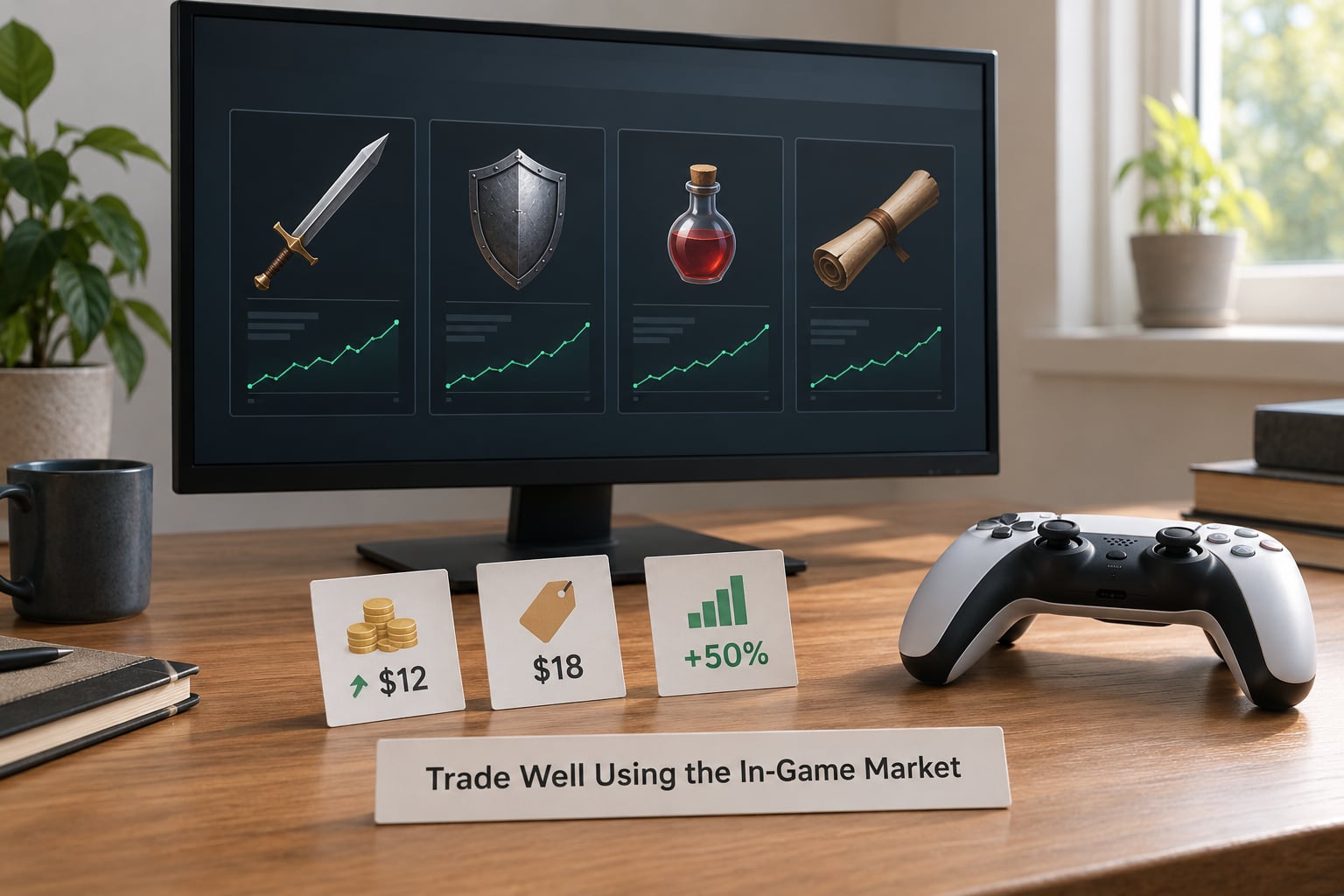
The in-game market has the highest ceiling of any method here, and it is the easiest one to lose real money in. You buy low, sell high, and the difference is your profit, so the skill is pricing rather than farming.
Read the market before you trade
Watch the price of one item for a few minutes before committing. Listings move with supply and demand, and an item whose price has been climbing is usually one other player is selling in volume right now. The obvious play, buying a common item and selling it at a markup, works until everyone arrives at the same listing price at the same time.
- Buy where supply is high, usually far from where demand sits.
- Watch storage limits, because a full market listing is a listing that does not pay.
- Set a markup you can accept quickly rather than waiting for a perfect buyer.
- Avoid overpaying for speed, since the price difference usually cancels the gain.
Repeatedly selling the same item can also reduce what buyers pay for it, so spreading across several goods protects the rate better than selling one item in bulk. Keep a portion of your stock rather than dumping everything, and the market behaves a lot more like trading than like a vending machine.
Frequently Asked Questions
Can I earn real money by playing open world games?
Not from ordinary gameplay. Every method in this guide produces in-game currency: credits, eddies, dollars or marks. The only established real-money routes are competitive titles with prize pools, content creation, or trading in-game items for real currency, and that last one usually breaks the terms of service of the game it happens in. Sites advertising easy earnings from playing games are almost always selling something.
Which game pays the fastest for legitimate money making?
In games with a live player market, trading has the fastest ceiling, though it needs starting capital. Without capital, delivery runs and repeatable contracts usually pay fastest because they need nothing but a vehicle and a few minutes. A rough order is: market trading and exports first, repeatable contracts second, loot selling third, and properties last because they take the longest to pay back.
Why am I still broke after a good farming session?
Because income is not profit. Ammunition, armour repairs, vehicle damage, fast travel and vendor fees come out of the payout before you see it, and a session that looks generous on the screen can end at a loss. Track your net instead of your gross: subtract everything you spent during the run from everything you collected. Most players who feel permanently broke are spending more than they think.
Do money trainers and console commands count as cheating?
They are treated as cheating in anything with online play, because they alter values the server is meant to track. In a single-player game, a developer console is usually allowed and a trainer rarely causes harm, but it does remove the challenge the game was built around. It also tends to break saves if the tool is wrong. If you want the full experience, stick to methods that work inside normal gameplay.
Is modding a way to make money faster in games?
Quality-of-life mods are fine on most single-player games and usually change nothing about economy balance. Mods that add money, spawn rare items or automate a grind loop are a different category, and they can be indistinguishable from cheating to anti-cheat systems in multiplayer titles. The safest rule is simple: if the mod moves money into your inventory, treat it as a cheat and do not run it online.
How do I stop being poor in an open world game as a beginner?
Start with repeatable missions and loot selling, because both need no capital and no knowledge. Sell to the right vendor type instead of the nearest one, keep a repair kit, and stop buying consumables you cannot afford to replace. Once a mission is worth more at a higher reputation tier, farm that tier rather than looking for a new system. Businesses and property come after the money is already flowing.
Conclusion
Start with the repeatable mission your game already offers you, run it three times in one sitting, and see what is left after repairs and consumables. Then sweep the progress screen for completion bonuses you never claimed, and hold a chunk of what you earn instead of spending it all immediately. Every method above works without a trainer, a console command or a mod, and the gap between a player who stays broke and one who does not is usually just which loop they picked and whether they tracked the cost.