Most upgrades in Los Santos Tuners change nothing that a lap timer can see. The ones that genuinely improve lap times are the engine, transmission, turbo, tires and brakes, because a circuit lap is decided by how fast you accelerate out of a corner, how hard you can brake into the next one, and how much traction the car holds while it turns. Armor and most cosmetic parts do not help, and heavy armor actively makes you slower.
That is the whole problem. The mod shop sells dozens of parts, the stat bars move constantly, and there is no obvious way to tell which change bought you anything. The method below replaces guessing with a repeatable process: find where you are losing the most time, match one upgrade to that loss, and prove it with repeated laps.
Table of Contents
- 1What You Need
- 2Step-by-Step: How to Pick Upgrades That Actually Improve Lap Times
- 3Start With the Biggest Limitation
- 4Match Upgrades to the Lap-Time Loss
- 5Measure the Same Lap Before and After
- 6Keep, Refine, or Replace the Upgrade
- 7Common Mistakes
- 8Frequently Asked Questions
- 9What upgrade usually improves lap times the most?
- 10Should I upgrade tires or the engine first?
- 11How many laps should I use to test an upgrade?
- 12How do I know whether an upgrade is actually faster?
- 13Can lightweight upgrades improve lap times?
- 14What is the best way to test upgrades on a tight track?
- 15Conclusion
What You Need

You need less than people expect. Five things, and four of them are free.
The vehicle. Pick the car you actually intend to race with. A car you only test with tells you nothing about a car you will use in a sprint or head-to-head, because weight and drivetrain behaviour differ between classes.
A clear list of upgrade categories. Engine, transmission, turbo, brakes, tires, armor, and everything else you can see in the mod shop menu. Write them down so you are comparing one line at a time.
A lap timer. The test track at the LS Car Meet runs time trials and records your best time, which gives you a hard number instead of a feeling. If you do not have access to that track, any repeatable route works as long as it is the same route every time.
Telemetry or stat bars. The mod shop screen shows the acceleration, top speed, handling and traction bars for the car in front of you. Note the four numbers before and after a change, because a bar that moves but a time that does not is the most common disappointment in this game.
A reset method. Know how to undo one change. Removing the part you just fitted and re-running the same laps is the only honest comparison, and it has to be repeatable or the test is worthless.
One fixed test route. Same track, same direction, same weather, same time of day. A lap measured in the rain at noon and a lap measured dry at night are not comparable, no matter how fast they look.
One note before you start: on PS5 and Xbox Series X|S you also have Hao’s Special Works, which adds a second acceleration bar and changes what the turbo can do. On PC, PS4 and Xbox One that option does not exist at all. Do not chase a build you cannot fit on your platform.
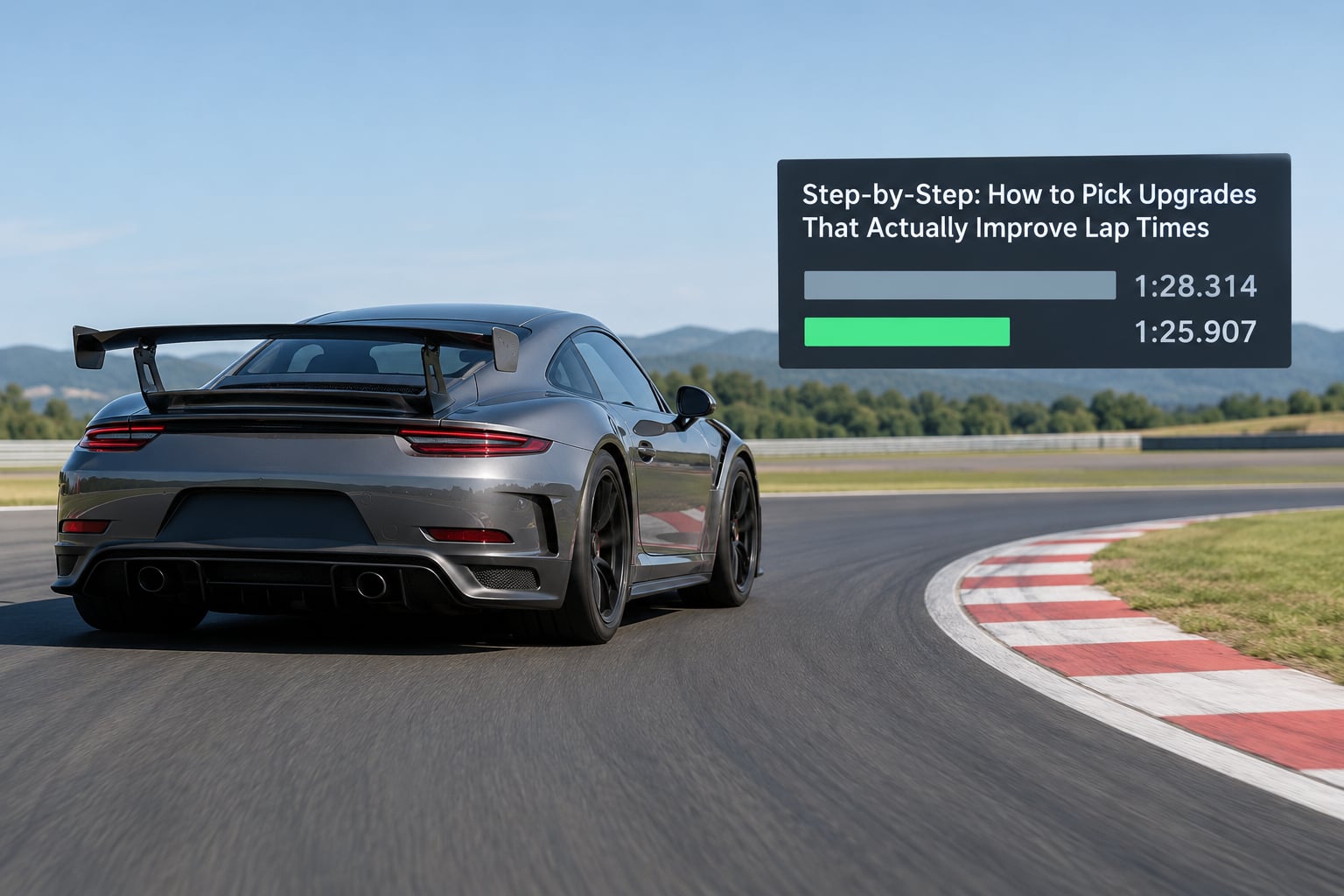
Step-by-Step: How to Pick Upgrades That Actually Improve Lap Times
Start With the Biggest Limitation
Diagnose before you buy. Run five clean laps on your test route and write down where the time goes, not just the total.
Slow off the corners? You are traction limited. The car spins its wheels or snaps sideways when you go back to full throttle. Grip and tires are the fix, not power.
Running wide or understeering into the apex? You are grip limited. Handling and tires matter more than the engine here, because a car that cannot turn the corner never gets to use the extra power.
Late and slow out of the hairpins? Look at gearing. A stock gearbox that shifts far too late wastes power every corner exit, and players on the forums consistently report that fitting a better transmission turned a slow car into a quick one.
Braking late and running past the corner? Brakes are your limitation. Brakes rarely add peak speed but they decide how much of the corner you get to use.
Never hitting top speed? Only then does top-end speed matter, and only on a track with long straights.
A tight technical layout punishes almost everything except tires and brakes. A long straight rewards the opposite. Diagnose on the track you will actually race, not on one that flatters the car.
Match Upgrades to the Lap-Time Loss
Now buy one part that addresses the weakness you just found. Fit it, check the four stat bars, and note which one moved.
Tires. Low Grip Tires, Rally Tires and Sport Tires are different tools. Sport Tires suit fast cornering on a circuit, Low Grip Tires suit technical layouts where you slide and control the slide, and Rally Tires trade outright grip for forgiveness on mixed surfaces. Note that the mod shop is the only source of Low Grip Tires, so plan for that if that is the direction you want.
Brakes. Shortening the braking zone converts an untouched corner into one you can attack. On most tracks this is the single biggest consistency gain available.
Engine and turbo. These raise acceleration and top speed. They help most when you already have the traction to put the power down, and they make a car harder to drive when you do not.
Transmission. This is the quiet one. It changes when the power arrives, which shows up as acceleration out of slow corners rather than as a higher top speed number.
Armor. Skip it for racing. The Heavy Hull option trades roughly a quarter of your top speed and acceleration for more armor, which is a deal worth taking in a pursuit race and a terrible deal in a time trial.
Everything else. Spoilers, exhausts, engine covers, intakes and the rest are appearance parts unless the stat screen says otherwise.
That last exception matters. Players report that anything other than the factory spoiler does raise performance on some cars, and a small number of vehicles carry hidden flags that reward a specific setup. So trust the stat screen in front of you over any rule, including this one.
Measure the Same Lap Before and After
Run five laps before the change and five after, on the same route, back to back, without touching anything else. Then compare the best lap and the average of all five.
The best lap tells you what the car can do at its theoretical peak. The average tells you what you can actually do repeatedly. For lap times the average is the number that matters, because a car you can only drive once in ten tries will lose you a race just as surely as a slow car.
If the best lap improved by a few tenths but the average did not, the upgrade is real but your driving is not exploiting it. That usually means the car now behaves differently and your braking points and throttle timing are wrong for the new balance. Fix the driving before buying another part.
If the best lap barely moved and the average got worse, the upgrade added power or weight the chassis cannot use. That is the case for reversing it.
Watch for the same car behaving differently between sessions. A track, a weather state or a traffic difference will swamp the effect of the part you are testing.
Keep, Refine, or Replace the Upgrade
Keep the change when both your best lap and your average improve by a margin larger than the spread between your laps. If your five laps range over more than the improvement, you have not measured anything yet.
Refine when the upgrade trades one area for another. More power with less traction means lifting earlier and driving smoother, and that is a valid choice on a track where corners dominate.
Replace it when nothing repeatable came out of it. Be honest here. Plenty of parts feel expensive and change nothing, and the fastest way to a better car is often a different car rather than another part on the same one.
For a public benchmark, the community runs roughly ten laps at Cutting Coroners GP with performance parts fitted, a method popularised by Broughy1322. Use it to compare your own numbers against other people’s builds. It also makes a useful point: on that benchmark, the gap between the best cars is smaller than the gap between the drivers.
Common Mistakes
Buying the most visually dramatic part first. A loud exhaust feels like progress and adds nothing measurable. Fix the weakness you measured, not the part you want to look at.
Changing several upgrades at once. Fit three parts, run a fast lap, and you have learned nothing about any of them. One change, one test, one conclusion.
Testing on different tracks or conditions. The numbers stop meaning anything the moment the route or the weather changes between the before and the after.
Ignoring your own driving. A huge share of a bad lap time is braking too late and flooring it too early. Before blaming the build, try a run where you brake earlier and carry more speed into the apex.
Trusting one fast lap. A single hero lap proves the car has a good moment. Five laps prove what it will do under pressure.
Assuming max upgrades is always fastest. The most common complaint from players is a car that spins out of control for every move once everything is maxed. Grip and brakes, not raw power, decide whether a lap time holds together.
Ignoring per-vehicle differences. A few cars respond to specific setups. Keep a short note of what works on each build instead of applying one rule everywhere.
Frequently Asked Questions
What upgrade usually improves lap times the most?
Tires and brakes, on most circuit layouts. A lap time is limited by how fast you can accelerate out of a corner, brake into the next one and hold the car while it turns. Power only converts into lap time once you have the grip and braking to use it, which is why players who max out the engine first often end up with a car that spins out of control for every move.
Should I upgrade tires or the engine first?
Tires, unless your car is traction limited everywhere rather than grip limited. If the car spins its wheels coming out of slow corners, tires help. If it runs wide mid-corner with the throttle barely touched, the engine is not your problem either and you need handling. Diagnose which one is actually costing you the time before spending anything.
How many laps should I use to test an upgrade?
Five laps before and five after, on the same route, with nothing else changed. The best lap shows the theoretical peak of the car. The average of all five is what actually decides a race, because a build you can only drive once in ten attempts will lose just as surely as a slow build.
How do I know whether an upgrade is actually faster?
Compare your best lap and your five-lap average before and after. A real upgrade improves both by more than the spread between your own laps. If only the best lap improved, the part is genuine but your driving is not using it yet, usually because braking points and throttle timing no longer suit the new balance.
Can lightweight upgrades improve lap times?
Yes, indirectly. Weight shows up in how eagerly the car changes direction and how much it squats under power. A lighter car usually rotates more willingly and puts its power down more cleanly. The effect is smaller than the effect of tires or brakes, so fix those first and treat lighter parts as a refinement.
What is the best way to test upgrades on a tight track?
Use the test track at the LS Car Meet, which runs time trials and records your best lap. On a tight layout, fit sport tires and brakes first and leave acceleration gains for later. Measure five laps before and five after on the same lap, because on a technical track the average matters far more than a single impressive run.
Conclusion
Start by finding the largest lap-time loss on your chosen track, then buy exactly one upgrade that addresses it, and prove it with five clean laps before and five after. If the average does not move, that part was not the answer, and no amount of extra purchases on top of it will change that. Repeat the loop one part at a time and your build ends up tuned rather than simply expensive.