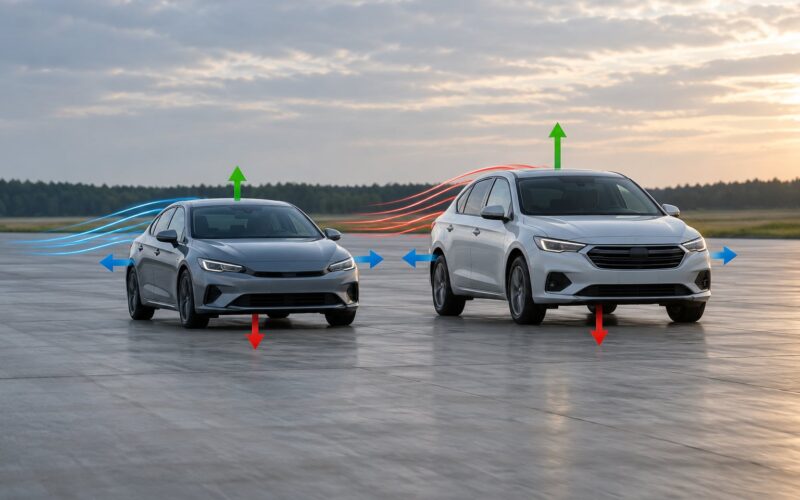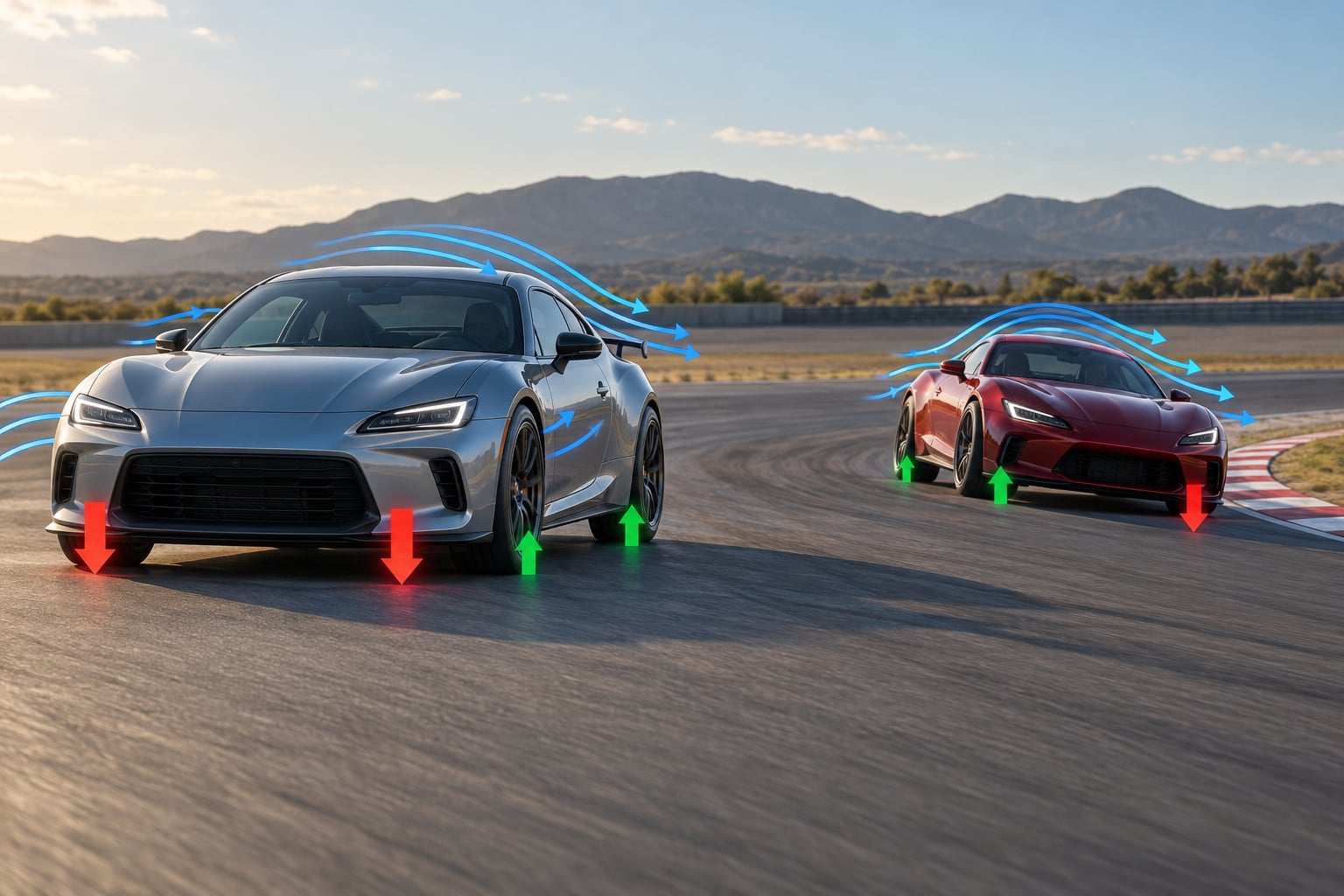
Game physics explained for car mods comes down to a simple split: the model you look at and the numbers the engine simulates are stored separately. Swap the bodywork, wheels and paint and nothing about the drive changes. Edit the vehicle’s physics data, and the car stops behaving like the one it replaced.
That gap causes most of the confusion in the modding communities. Someone installs a hypercar with a wide body kit and a big rear wing, expects it to corner like the real thing, and gets the stock handling of a hatchback. The fix is rarely a spoiler. It is understanding which value actually moves the car, then changing it in the right order.
Table of Contents
- 1Game Physics Explained for Car Mods: The Quick Answer
- 2What Is Game Physics in a Car Mod?
- 3How Do the Main Physics Systems Work?
- 4Game Physics Explained Through the Forces on a Car
- 5Why Do Some Car Mods Feel Faster but Drive Worse?
- 6How Mass, Power, and Grip Affect Handling
- 7How Aerodynamics and Suspension Change the Drive
- 8Which Physics Values Should You Change First?
- 9How to Test a Car Mod Without Guessing
- 10How Do You Fix Common Physics Problems?
- 11Frequently Asked Questions
- 12What makes a car mod feel realistic?
- 13How much power should I add to a car mod?
- 14Why does my car mod understeer or spin out?
- 15Should grip be increased when I add a more powerful engine?
- 16Do car mods need custom physics for every GTA game?
- 17Conclusion
Game Physics Explained for Car Mods: The Quick Answer
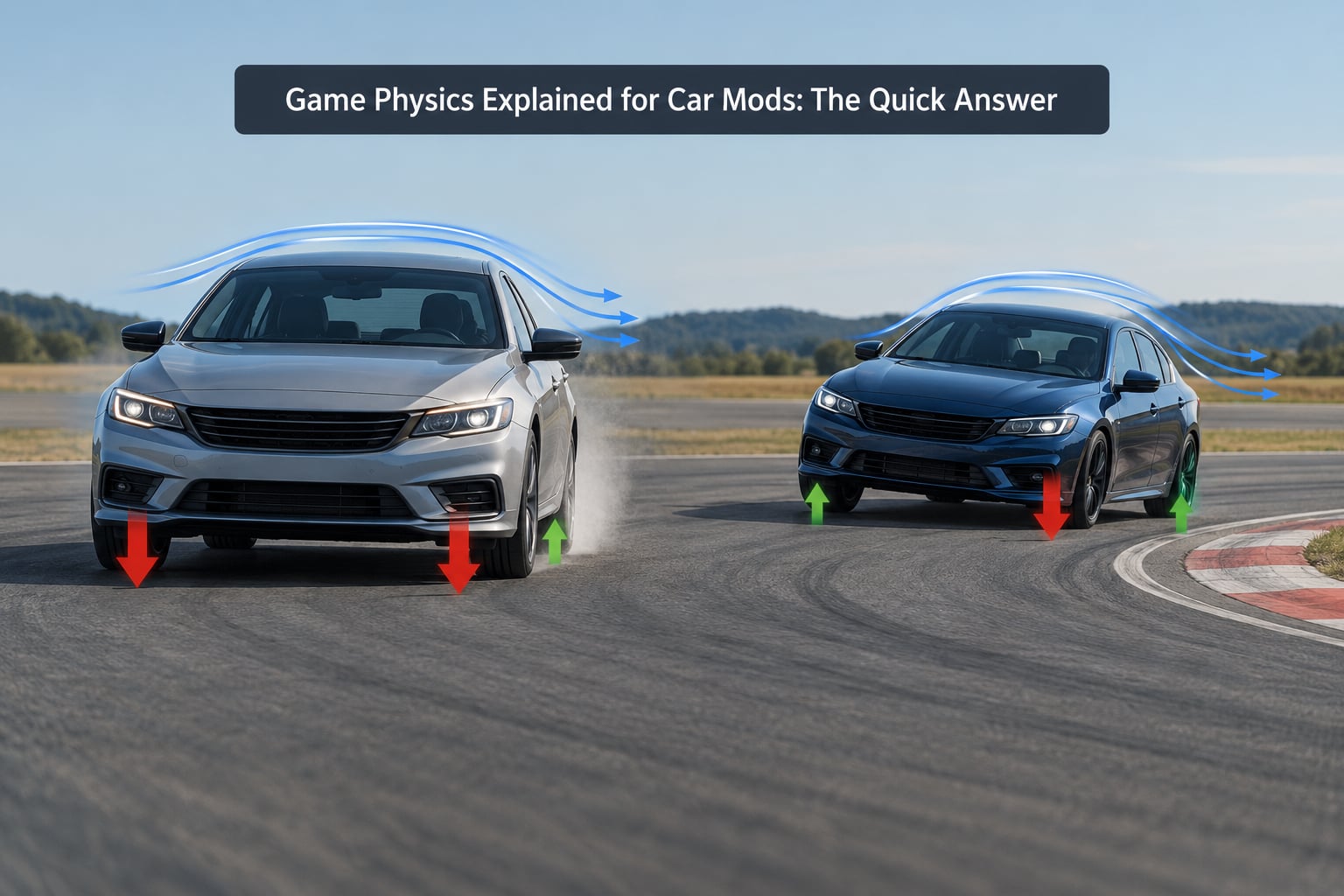
Game physics is the set of simulated forces a game engine applies to a vehicle model to decide how it accelerates, corners, slides and crashes. Convincing car mods balance power, mass, tire grip, aerodynamic drag and suspension rather than maximising any single value.
Every car runs on the same seven systems, whether it is a GTA handling meta file, an Assetto Corsa setup, Forza tuning sliders or a BeamNG node-and-beam structure.
- Mass and center of gravity — how much the car weighs and where that weight sits.
- Tire friction and slip angle — the grip a contact patch generates and at what steering angle it peaks.
- Suspension rate, travel and damping — how load moves through the four corners and how fast it settles.
- Engine torque and gearing — how force is delivered and at what speed.
- Weight transfer — the load shift caused by braking, acceleration and cornering.
- Collision and damage mass — what happens when the car hits something.
- Aerodynamics — drag and downforce scaling with speed.
What Is Game Physics in a Car Mod?
Visual modeling is geometry, materials, lights and polygons. It answers what the car looks like. Physical simulation answers what the car does, and it reads values from a physics data file rather than the mesh.
This is the single most common misunderstanding in car modding. A stripped interior, custom rims and a rear diffuser are all visual files. Unless the author also edits the physics data, installing them changes the car’s appearance and nothing else. Users report this confusion constantly in GTA and Forza mod groups, and it explains why performance upgrades often seem to do nothing.
| Physics system | What it controls | Unrealistic symptom it causes |
|---|---|---|
| Rigid-body movement | Position, rotation and inertia of the chassis | Car spawns underground or launches on contact |
| Mass and center of gravity | Acceleration, braking, weight transfer | Snaps out of corners or feels weightless |
| Tire friction | Traction and lateral grip limits | Car slides at low speed or refuses to turn |
| Suspension | Load movement, ride height, roll control | Constant bouncing or body roll in corners |
| Engine torque and gearing | Power delivery and top speed | Instant full-throttle acceleration or a low top speed |
| Collision geometry and mass | Crash response and damage | Car passes through walls or bounces violently |
| Aerodynamics | Drag and downforce at speed | Unstable above a certain speed or no speed gain |
How Do the Main Physics Systems Work?
The engine runs a physics loop many times per second. In each step it reads your throttle, brake and steering inputs, computes the forces each tire can produce, applies those forces at the contact patches, integrates them into a new position and rotation for the chassis, then reacts the suspension springs and dampers so the body does not simply fall through the ground.
Gravity and aerodynamic loads are added into the same calculation. Once the sideways force a tire needs exceeds what its friction limit allows, the tire is allowed to slide, and that slide is what players experience as grip breaking away.
Change mass, spring rate, grip or downforce in the vehicle’s physics data and every one of those downstream results changes with it. That is why small edits produce large differences, and why copying a setup from another car without adjusting mass is the most common source of an undriveable mod.
Game Physics Explained Through the Forces on a Car
Six forces do almost all of the work. Each maps to a specific configuration field, and each has a characteristic failure when it is set wrong.
| Force | Typical field | Observable effect | Common mistake |
|---|---|---|---|
| Tractive force | Engine torque, mass, final drive | How hard the car pulls away and accelerates | High power with no gearing range to match |
| Braking force | Brake bias, brake torque | Stopping distance and nose dive | Brake grip far above tire grip |
| Lateral grip | Tire friction, slip curve, downforce | Cornering speed and turn-in | Grip raised without matching weight |
| Gravity and weight transfer | Center of gravity height | How load shifts between the four tires | Raising the CG to fix a model clipping the road |
| Drag | Drag coefficient, frontal area | Top speed and high-speed stability | Drag left at stock while power is doubled |
| Rolling resistance | Tire model, surface friction | Coast-down speed and economy | Set too high, so the car never rolls freely |
Menu names and file fields differ per game and per modding tool, so treat the field names above as concepts rather than labels to search for literally.
Why Do Some Car Mods Feel Faster but Drive Worse?
Because a spec sheet and a good driving experience are different targets. Modders often raise engine output first, then notice the car spins its wheels, refuses to turn in, or becomes unstable at speed, and assume the power is the problem.
The usual causes stack up. Excessive power overwhelms the rear tires on exit and spins the car. Unrealistically low mass makes every force act harder, so the same grip number produces twitchier behavior than it should. Weak grip leaves the tires saturated, so grip changes stop responding predictably and the car simply slides.
Abrupt tire transitions make this worse. If a simulated tire goes from full grip to no grip in one step rather than falling off a curve, the car snaps instead of washing out, and no amount of suspension tuning fixes a sudden loss of all lateral force.
Poor suspension control adds its own problem: load arrives at the tires late and leaves late, so grip is never where the driver expects it. Inconsistent collision geometry, such as a bounding box far larger than the visible body, produces phantom hits and cars that refuse to sit still on slopes.
How Mass, Power, and Grip Affect Handling
Mass sets how strongly every other force acts. Double the mass and the same engine torque produces half the acceleration. Halve it and every input becomes sharper, including the ones that spin the car.
Top speed is a drag-limited number, not a power number. Once a car reaches the speed where aerodynamic drag equals the force available at the wheels, extra power buys you nothing until that balance changes. This is why a heavily modified car can feel dramatically quicker for its first minute and still top out exactly where the original did.
Braking depends on the friction limit, not on brake force alone. Once the tires are at their limit, more brake pressure only makes them lock. Cornering works the same way: the vehicle generates lateral force until load, grip and slip angle allow it.
Weight transfer is the connection between all of it. Braking shifts load forward, which puts grip on the front axle for turn-in. Cornering shifts load to the outside tires. Throttle shifts it rearward, which is why a powerful car can lose grip exactly when you ask it to accelerate out of a corner.
A worked example: an engine upgrade that adds substantial torque without adding mass or grip will rotate the rear axle under power sooner, transferring more load rearward, reducing rear lateral grip and increasing understeer on entry. The car is faster in a straight line and worse everywhere else.
How Aerodynamics and Suspension Change the Drive
Drag rises with speed and limits top speed. Downforce presses the car into the road with speed, adding grip in corners, but only at higher speeds. A visual spoiler adds downforce only if the physics data says it does, which is why the model on the bootlid is often irrelevant.
Center of gravity height controls how far load moves for a given force. Lower is usually better for grip; raising it to stop the body clipping a surface trades real handling for a cosmetic fix.
Spring rate decides how much force is needed to compress the suspension. Damping controls how that motion is absorbed on compression and released on rebound. Anti-roll bars distribute roll stiffness between axles, deciding which end does more of the work in a corner.
Extreme values reduce stability rather than improving it. Very soft springs let the body float between transitions, so grip arrives late. Very stiff springs make the car skip over bumps and lose contact. Damping set far too high locks the suspension into whatever position it starts in, so the tires never follow the road.
Which Physics Values Should You Change First?
Work in a fixed order. Each step depends on the one before it, and changing them out of sequence means you cannot tell which edit caused the change in behavior.
- Decide the car’s intended role. Street, track, drift or off-road. Everything after this is judged against that target.
- Fix scale and mass. Confirm the model is the correct size and that its mass and center of gravity are plausible for the vehicle. Wrong scale is the root of underground-spawning and flying-away bugs.
- Tune power delivery. Set engine output and gearing together so the torque band matches the gear ratios.
- Match grip to weight. Tire friction and downforce should follow the mass you just set, not precede it.
- Calibrate braking. Set brake force and bias against the actual grip limit, and confirm the nose dives sanely.
- Stabilize the suspension. Springs, then damping, then anti-roll balance. Change one component per test.
- Refine aerodynamics and effects. Drag, downforce, tire wear and damage model last, once the car is already behaving predictably.
Exact menus and file fields vary by game and by the modding tool you use, so treat this as a diagnosis order rather than a set of specific buttons.
How to Test a Car Mod Without Guessing
Set up a repeatable routine and change one variable at a time. Without that, every session blends several edits into a single unclear result.
Run a flat straight-line acceleration test, then a roll-down test with no input to measure drag and rolling resistance. Follow with an emergency braking test from a known speed on a flat surface, and a steady-state cornering test at constant steering angle to see whether the car holds a line or drifts wider.
Then push past the threshold deliberately: turn in until the tires slip and note where the car settles. Run the same corner over a bump and up a slope. Test a low-speed collision and a high-speed one separately. Finish with a top-speed run to see whether you are drag-limited or power-limited.
Write down what you changed and what you measured before moving on. A simple note with three values and a one-line impression per test is enough to make the next change readable.
How Do You Fix Common Physics Problems?
Match the symptom first. Most handling problems have a small number of common causes, and guessing at random makes them worse.
| Symptom | Likely cause | Controlled correction |
|---|---|---|
| Spawns underground or flies away | Collision box, mass or center of gravity mismatched to the model | Verify scale and mass against the source vehicle, then re-test |
| Instant torque with no wheelspin control | Torque curve too aggressive, first gear too short | Reduce low-end torque or lengthen the first ratio, then retest acceleration |
| Constant understeer | Front grip too low, or center of gravity too high | Fix mass and CG first, then add front grip in small steps |
| Snap oversteer on exit | Tire slip curve too abrupt, or power arriving late in the corner | Soften the slip transition and smooth torque delivery |
| Excessive braking grip | Brake force above the tire friction limit | Lower brake force until stopping distance stops improving |
| Constant bouncing | Damping too low or rebound too high for the spring rate | Raise compression damping first, then reduce rebound |
| Unstable at high speed | Insufficient downforce relative to power and drag | Add downforce, or reduce power, then retest at speed |
| Wheels behave inconsistently | Suspension travel too short, wheel-arch clipping | Raise ride height evenly, then restore travel |
| Incorrect driving position | Driver node offset in the model rather than a physics value | Reposition the driver node in the model file, not the handling data |
Frequently Asked Questions
What makes a car mod feel realistic?
Realistic handling comes from a coherent set of values rather than any single extreme one. Mass, center of gravity, tire grip, power, gearing, braking and suspension need to agree with each other. A car with believable mass and grip, a torque curve that builds gradually, and suspension that settles quickly after a load change reads as realistic. Adding extreme power without adjusting weight usually makes a car feel less real, not more.
How much power should I add to a car mod?
Add power in proportion to what the car can actually put down. If you do not also raise grip or downforce, or lighten the car, the extra torque will only spin the tires and unsettle the car on corner exit. A sensible approach is to raise engine output moderately, then re-run your acceleration and cornering tests before going further. If traction falls apart before you reach the power you wanted, grip is the next value to change.
Why does my car mod understeer or spin out?
Understeer usually means the front tires have run out of grip, often because mass or center of gravity is wrong, front friction is too low, or grip drops sharply past a small slip angle. Spinning out points to the opposite: rear grip failing on power or on a sudden weight transfer. Start by fixing scale and mass, then adjust grip on the axle that is losing it. Changing both axles at once hides which value is actually responsible.
Should grip be increased when I add a more powerful engine?
Usually yes, because more torque needs somewhere to go. More power increases the force the drive tires must transmit, so grip has to rise with it, either through tire friction or through downforce at speed. If you raise power and grip together, also re-check braking, because brake force has to stay inside the new grip limit. Raising power alone produces wheelspin and unstable behavior under braking.
Do car mods need custom physics for every GTA game?
Each GTA title ships its own handling data and its own file structure, so a car built for one version is not automatically correct for another. Differences in the engine, handling format and default values mean a mod that drives well in one game may need its physics data reworked for another. Patches have also rebalanced handling values over time, which changes how the same numbers behave. Always test in the specific version and platform you are targeting.
Conclusion
A convincing car mod is a set of values that agree with each other, and most disappointing ones are not far off in any single value. Pick a believable performance target, fix the car’s scale and mass, then work through power, grip, braking and suspension in that order, testing one variable at a time.
One habit pays off more than any other: keep the physics data in its own file next to the model, and note down each change you make. Six months later, when the car behaves strangely, that note is the difference between a five-minute fix and a full rebuild.