You drive better in arcade racing games by controlling entry speed, holding one repeatable line, and timing drift boosts on the exit. Braking before the corner instead of during it, and easing the throttle on the way out, is where most of the time comes from. None of it needs new hardware.
The reason so many players stall out is that most driving advice out there was written for sim racers. Brake bias, tire temperature, aero balance. Read that, apply it in a kart game, and you will be slower within an hour.
Arcade racers use a simplified handling model: grip is mostly fixed, steering snaps toward a limit rather than ramping smoothly, and much of your speed comes from drifts, boost pads and slipstream rather than from raw grip. Learning how to drive better in arcade racing games means learning that model on its own terms.
Below is a nine-step routine. Each step tells you what to practice and how to tell it worked, so you can tell whether a session improved anything or just felt different.
Table of Contents
- 1What You Need
- 2Step-by-Step
- 3Master the controls before raising your speed
- 4Build a repeatable warm-up routine
- 5Use a consistent line to drive better in arcade racing games
- 6Brake before the corner, not during it
- 7Match throttle input to available grip
- 8Carry speed without locking up the front tires
- 9Use deliberate, controlled drifts
- 10Recover errors without ending the run
- 11Measure consistency instead of chasing one perfect lap
- 12Common Mistakes
- 13Frequently Asked Questions
- 14Is a controller better than a keyboard for arcade racing games?
- 15Should I use driving assists or manual transmission in an arcade racing game?
- 16Why does my car understeer when I enter corners too fast?
- 17What is the best way to learn the controls of a new arcade racing game?
- 18How do I drive faster without making more mistakes?
- 19Should I practice drifting in an arcade racing game?
- 20Conclusion
What You Need
No wheel, no pedal set, no special controller. You need a car and a track you know, which almost every arcade racer gives you from the first race.
What does help is choosing the right setup for the input you already own:
| Input | Start with | The one thing to fix |
|---|---|---|
| Keyboard | Full steering lock, throttle on the fastest key you can hold comfortably | Key rollover during hard steering and throttle together |
| Analog stick | Steering around 40 to 60 percent, a small deadzone, linear steering | Sensitivity too high, so every tap reads as a swerve |
| Arcade stick | Linear steering, digital gate for the wheel, button layout you can find blind | A tight gate that gives you less than half a turn of lock |
| Wheel | Linear steering, a lock of 200 to 540 degrees, throttle at 70 percent | Using a high lock on a track with slow corners, which hides trail braking |
Two other things matter more than hardware. Know which lap-time counter the game shows you, so you can compare sessions. And find out whether the game has a time trial or ghost mode, because that is where this routine actually gets practiced.
Step-by-Step
Master the controls before raising your speed
Predictable inputs beat the most responsive settings, every time. A car that responds instantly to a small stick push feels twitchy, and twitchy is slow, because you end up making corrections instead of steering.
Turn steering sensitivity down until the car tracks where you point it, set steering to linear rather than curved where the game offers both, and keep a small deadzone on analog sticks so a resting stick never drifts the wheel. Set assists to whatever the game calls standard, not maximum.
Menu names and ranges differ between arcade racers, so treat these as starting points rather than settings to hunt for. Exact paths live in each game’s options screen.
You have it when you can hold a long constant bend without touching anything outside the stick.
Build a repeatable warm-up routine
Most bad laps start in the first three corners, before you have warmed up. Two minutes of easy driving fixes that.
Accelerate gently to about half throttle until the tires settle, brake once in a straight line to a full stop, then do five slow circles in both directions. Finish with one full-throttle launch on a clear stretch and one stop from speed.
The purpose is rhythm, not speed. You are teaching your hands how the car feels today, because grip changes with assists, with the car you picked, and with whatever the game does in the first lap.
You have it when you stop missing the first corner after a warm-up.
Use a consistent line to drive better in arcade racing games
Choose one line and repeat it. Outside, inside, outside is the standard path, and the value is not the corner speed, it is the exit. A slightly wider entry that lets you stay on the throttle beats a tight entry that scrubs off all your speed.
Place the car deliberately two corners ahead. Players who react only to what the car is doing right now are always late, which is why planning a couple of corners ahead keeps showing up as the standard advice: the line is decided long before the steering moves.
Accept a slightly wider entry when the alternative means stabbing the brakes mid-corner or kissing the wall. In arcade racers, contact costs more time than width.
You have it when a replay shows you taking the same line lap after lap instead of a new one each time.
Brake before the corner, not during it
This is the single biggest time gain in the whole guide. Brake in a straight line, then turn. Most lost time in arcade racers comes from arriving too fast, and arrival speed is set by where you pressed the brake, not by how hard you pressed it.
Pick a fixed marker for each corner, like a white line or a gap in the barrier, and use it every lap. Then add a small amount: as you turn in, ease off the brake slightly rather than releasing it. That is trail braking, and in arcade handling models it usually just rotates the car a touch so it points down the exit instead of washing wide.
Locked brakes mean no turning at all. If the front gives up mid-corner, you braked too late or too hard, and the fix is at the previous corner, not here.
You have it when you can name your braking marker for a corner and hit it the same way on every lap.
Match throttle input to available grip
Most arcade cars give you one or two throttle states, so the skill is choosing when to use which. On corner exit, start with about half throttle and hold the line, then add more as the car straightens.
If the rear steps out as you add power, you added too much too early. Back off, let the car settle, and try again. If the car feels like it will not turn in at all, that is understeer and the fix is entry speed, not steering input.
On a loose-surface or rally-style car, earlier throttle works better because the rear already has less grip. On a kart, wait until the steering is nearly centered before you stamp it.
You have it when your exits stop looking like a car kicked sideways and start looking like a car being launched.
Carry speed without locking up the front tires
Understeer is the game telling you the front tires have run out of grip. In an arcade racer the fix is almost always to slow the entry, not to add steering.
Small, smooth steering inputs help. Sawing the wheel left and right across the center of the corner scrubs speed and unsettles the car, and rapid taps are why analog players describe their cars as twitchy. When you are working near full lock, the car should still answer immediately; if it does not, you are already past the limit.
Look where you want the car to go, not where it currently points. That single habit fixes more understeer than any setting change.
You have it when the car turns when you ask and stays quiet when you leave it alone.
Use deliberate, controlled drifts
Drifting in an arcade racer is a speed mechanic, not a show. The drift charges a boost, the boost pays out on exit, and a drift held through the apex and released straight is worth far more than a short twitchy one.
Enter with a deliberate tap of the handbrake or drift button, hold the throttle steady rather than stabbing it, and countersteer only as much as you need to keep the nose pointed at the exit. The cleanest version of this is third gear, a feathered throttle, and an e-brake used at a moment you chose rather than in a panic.
Practice it where a mistake costs nothing, on a wide corner or an empty practice session, before trying it mid-race. And keep drifting for corners that genuinely benefit. Drifting every corner is slower than driving four of the five cleanly.
You have it when your drift charges build and release on cue instead of fizzling out halfway.
Recover errors without ending the run
A mistake does not have to end the lap. In an arcade racer, a spun car usually costs a few seconds; a spun car plus a full stop costs a race.
When you slide or spin, take a moment off the throttle, let the car slow enough to regain grip, and steer it toward the direction you are traveling rather than where you were pointing. Once it is straight and moving, aim for the racing line and rejoin. Do not try to save it with more steering; that is what spins it a second time.
After a wall strike, do not sit on the throttle while you line up. Roll off, straighten, drive out. In checkpoint and time-attack modes, a clean rejoin protects your time far better than an aggressive launch into the next wall.
You have it when a slide in turn three no longer means you lose the whole race.
Measure consistency instead of chasing one perfect lap
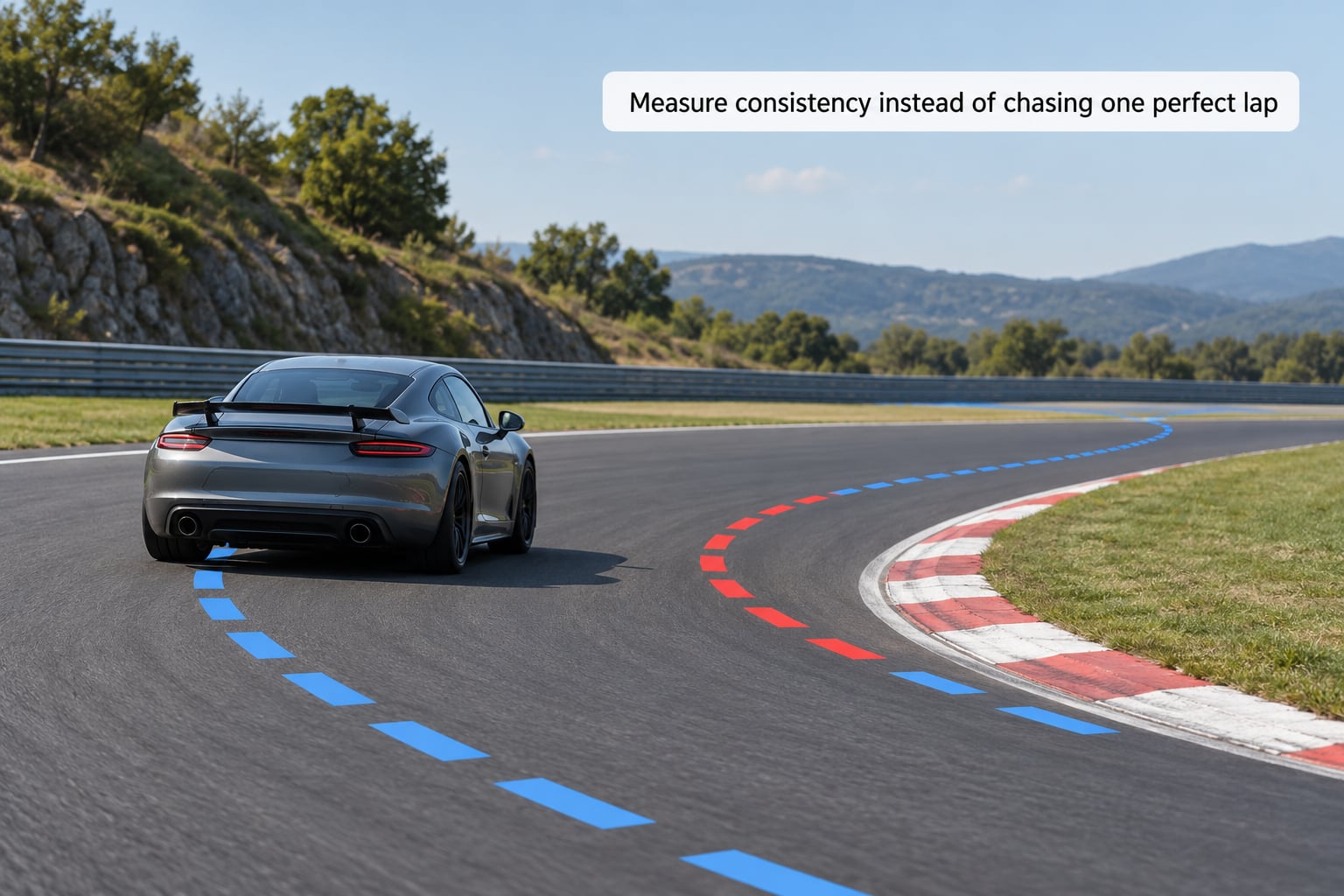
One fast lap is luck. Three laps within half a second of each other is a lap time you can race on.
Run sets of three laps in time trial, and write down two things: the spread between your slowest and fastest lap, and how many times you hit a wall. Aim for five clean laps in a row before you start chasing fractions of a second.
Change one variable per session. Turn sensitivity down on day one and leave it; try trail braking on day two. Players who fix braking and throttle in the same session usually end up fixing neither, because they cannot tell which change did what.
Once a set is consistent, compare it against a ghost lap if the game has one. That turns an opinion into a number.
You have it when your best lap and your average lap are close together.
Common Mistakes
Six habits cause nearly every slow lap, and each has a direct fix.
- Too much entry speed. Fix: move your braking marker earlier and drive the corner slower for ten laps. Almost every understeer complaint disappears.
- Abrupt steering. Fix: halve your steering inputs for a lap. If it feels slow, you have found the amount the car actually needs.
- Holding full throttle after contact. Fix: roll to a stop, straighten, drive out. Full throttle into a wall just buries you deeper.
- Drifting everywhere. Fix: drive the first four corners of every lap without drifting, then use a drift only where the boost pays for itself.
- Practicing on a different car every session. Fix: one car for two weeks. The handling differences are real enough that switching resets your muscle memory.
- Changing several settings at once. Fix: one setting, one session, and write down what happened.
One more worth naming: playing only races. Races hide your mistakes in traffic. Time trial with a ghost shows you exactly where the time went, which is why most of this routine happens there.
Frequently Asked Questions
Is a controller better than a keyboard for arcade racing games?
A controller is easier to drive well with, mainly because analog steering lets you make small corrections instead of snapping between full lock and center. Keyboard play is completely viable though, and plenty of players set lap times on it. If you are on keyboard, the thing to fix is key rollover during hard steering and throttle, not your technique. Every tip in this guide works on both.
Should I use driving assists or manual transmission in an arcade racing game?
Turn assists on at the level the game calls standard while you learn the track. Traction and stability assists hide the understeer that tells you your entry speed was too high, so running them at maximum makes your later attempts harder. Manual transmission matters less in arcade racers than in sims, because most have few gears and auto shifting keeps your hands on the wheel. Try manual once you are consistent.
Why does my car understeer when I enter corners too fast?
Understeer means the front tires have run out of grip, so the car keeps going straight no matter how much you steer. In arcade handling models this is almost always entry speed, not a settings problem. Brake earlier using a fixed marker, and add throttle progressively on the exit rather than steering harder into the corner. If the car still washes wide at a slower entry speed, turn your steering sensitivity down.
What is the best way to learn the controls of a new arcade racing game?
Spend the first session on controls, not on winning. Set sensitivity and steering linearity, then drive slowly for a few laps with assists on so the car feels predictable. Learn where the brake, drift and boost controls sit before you need them mid-race. A repeatable warm-up of gentle acceleration, one braking stop and some slow circles gets the hands calibrated faster than any amount of racing.
How do I drive faster without making more mistakes?
Drive a consistent line and let corner exit do the work instead of braking later. Pick one braking marker per corner and hit it the same way every lap, then use half throttle until the car straightens. Measure three-lap sets and aim for a small spread between your best and worst lap rather than a single fast one. Consistent laps get faster; hero laps usually do not.
Should I practice drifting in an arcade racing game?
Yes, but practice it deliberately and only where it pays. A drift charges a boost that is released on exit, so a long drift held through the apex and finished straight is much faster than a short twitchy one. Practice in wide corners or an empty session first, use third gear with a feathered throttle, and use the handbrake at a moment you chose. Drift on maybe one corner in five.
Conclusion
The progression is short. Get the inputs to feel predictable, warm up so your hands know the car, pick one line, brake before the corner, then ease the throttle on the way out. Everything past that, drifting and recovering from slides, is a refinement on those five.
Start on a track you know, with the car you already own. Run three-lap sets, keep one variable fixed per session, and do not chase a single fast lap until your worst lap is close to your best. That is how you drive better in arcade racing games, and it works on whatever you are playing on.