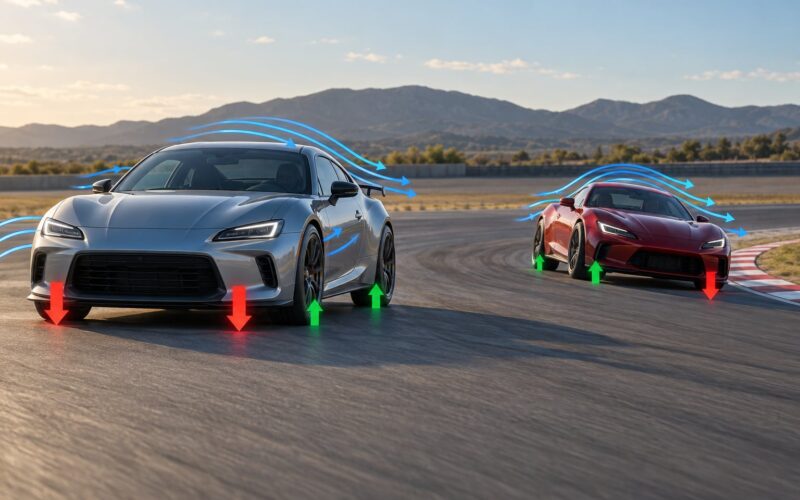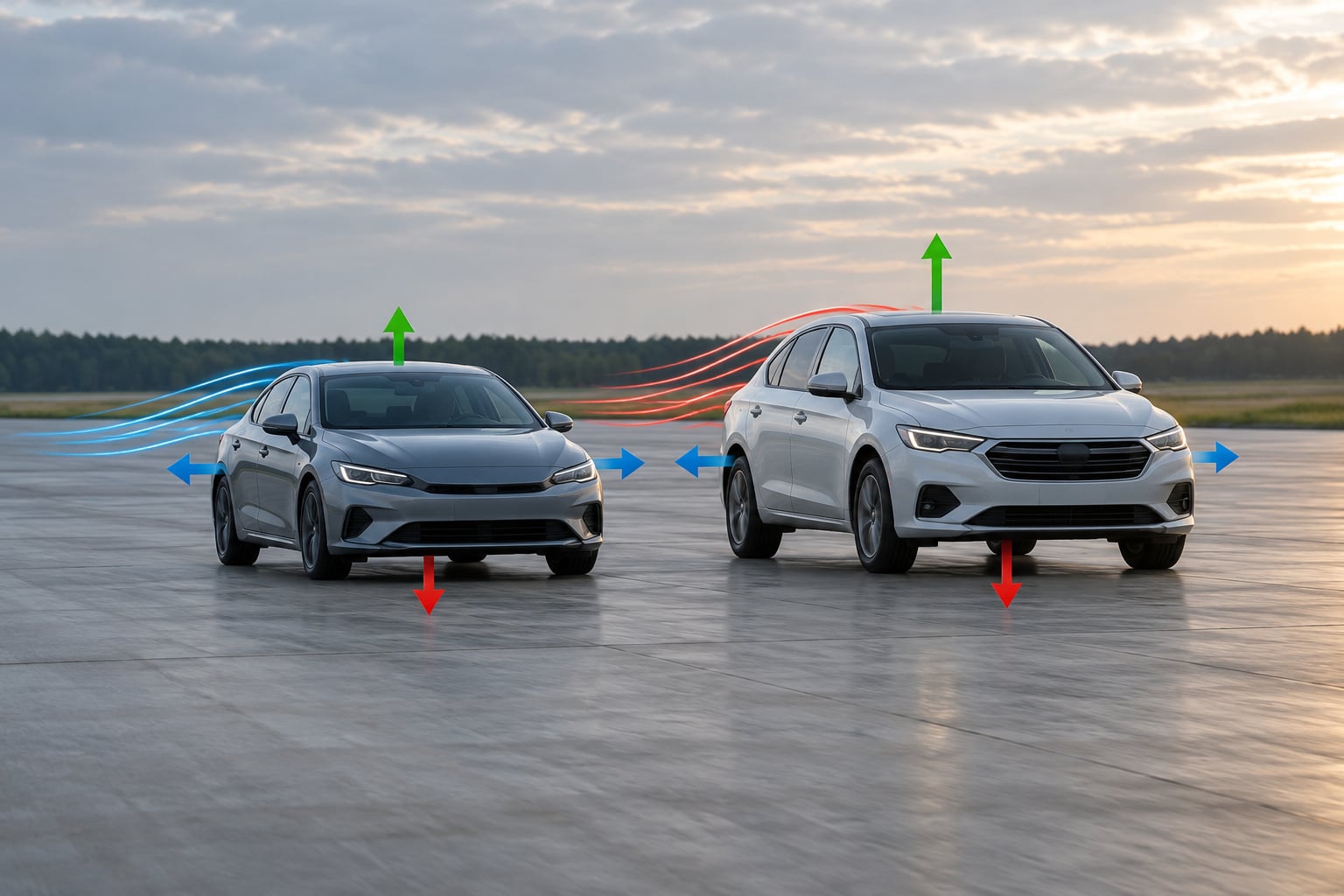
In game physics, a car’s weight is a mass number, and that number decides how hard the car is to push, stop and turn. Heavier cars accelerate and brake more slowly, carry more load into every tire so grip rises less than the mass does, transfer more weight onto one corner in a bend, and hit things harder. Understanding how car weight affects handling in game physics matters whether you build a vehicle model or just edit one in a mod.
Most of the confusion here comes from treating mass as a single dial. It isn’t. Mass enters a vehicle simulation in four separate places, and each one has its own effect on how the car feels. Once you can name those four, tuning weight stops being guesswork and becomes arithmetic you can check.
The numbers below come from an ordinary mid-size sedan rather than a supercar, because that is the range most game vehicles are modeled on. Swap the values for your own vehicle and the relationships still hold; only the constants move.
Table of Contents
- 1How Car Weight Affects Handling in Game Physics
- 2What Car Weight Means in a Physics Engine
- 3How Weight Changes Acceleration and Braking
- 4Sprung mass versus unsprung mass
- 5Why Heavier Cars Feel Different in Corners
- 6Why more load means less grip
- 7Understeer, oversteer and rollover
- 8Measuring what weight is actually doing
- 9How Weight Influences Collisions, Air, and Downhill Driving
- 10How to Tune Car Weight Without Breaking Handling
- 11The reference table of handling parameters
- 12Why very heavy vehicles stop working
- 13Arcade or simulation: when to ignore real mass
- 14How Car Weight Affects Handling in Game Physics in Practice
- 15Common Weight-Tuning Mistakes
- 16Frequently Asked Questions
- 17Should I change a vehicle’s mass when I edit its visual model?
- 18How do game engines handle vehicle mass differently?
- 19What unit system should I use when tuning vehicle physics?
- 20Does a lighter car always handle better in a racing game?
- 21How can I tell whether a handling problem comes from weight?
- 22Should mass changes be balanced differently in multiplayer games?
- 23Conclusion
How Car Weight Affects Handling in Game Physics
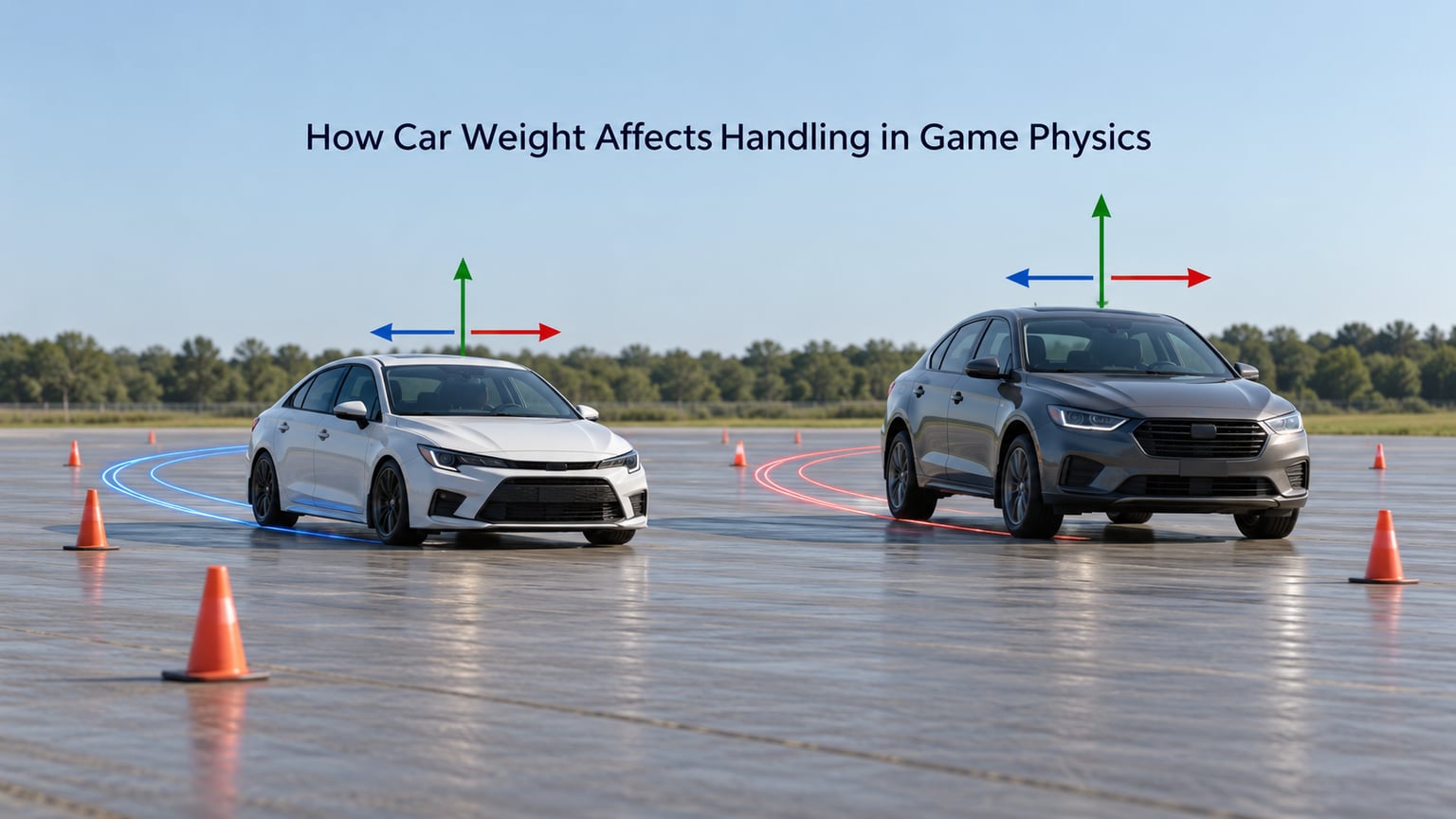
How car weight affects handling in game physics comes down to four things: heavier mass lowers acceleration from a fixed engine force, lengthens braking distance, shifts more load onto one corner during a turn, and resists rotation more strongly. Tire grip only rises with load, and less than proportionally, so a heavier car feels lazier and less sharp rather than just slower.
Here is the same car at two different mass values, everything else held identical. Read the cornering row twice — that is where the interesting part sits.
| Behaviour | Lighter version | Heavier version | Why |
|---|---|---|---|
| Acceleration | Higher 0-100 figure, snappier off the line | Lower and more progressive | Same drive force spread over more mass, F = ma |
| Braking | Shorter stopping distance | Longer stopping distance | More kinetic energy to absorb, tire friction limits scale |
| Cornering | Rotates into the corner quickly, sharper turn-in | Slower turn-in, more body roll, more understeer on entry | Longer braking distance, higher yaw inertia, more load on outer tires |
| Stability | Snappier, easier to spin | Calmer, more planted, harder to rotate | More rotational inertia resists sudden yaw |
| Collisions | Pushes another car aside | Shoves hard, transfers big impulse | Momentum and kinetic energy both scale with mass |
| Road feel | Wheels follow surface detail closely | Rides over bumps, settles late | More energy absorbed per suspension stroke |
| Jump landings | Stays level, recovers fast | Pitches and rolls, may bounce | Higher rotational inertia and higher load on the suspension |
The row that catches people out is stability. A heavy car feels more forgiving for the first two laps, then frustrates you when you ask it to change direction. That trade is the whole story of weight in vehicle handling.
What Car Weight Means in a Physics Engine
A physics engine never stores your car’s weight. It stores mass, measured in kilograms, and derives everything else from it. Weight is what gravity does to that mass, which is why an engine’s mass value stays constant while the force on it changes with pitch and roll.
Four values are worth separating cleanly:
- Mass — how much matter the car is. One scalar, in kilograms. This is what you set in the inspector.
- Weight — the gravitational pull on that mass, roughly mass times 9.81 in newtons. It scales with mass and changes as the car pitches.
- Moment of inertia — resistance to rotation. It depends on mass and how far that mass sits from the rotation axis, so a tall car resists body roll far more than a low one of identical mass.
- Center of mass — the single point you can pretend all the mass hangs from. Its height decides how much load moves per g of lateral acceleration.
Density is the bridge between what you see and what the engine simulates. A blockout mesh is a volume of geometry, not a car, and its calculated mass depends entirely on the density value assigned to it. Halving the mesh does nothing until the density is right.
Visual size, wheel count and engine power do not feed into mass on their own. A model with four wheels and a bigger engine block still has the mass the density produced, unless you change it. This is the source of the single most common modding bug: someone swaps in a wider body kit, the collision hull grows, the computed mass jumps, and the car now brakes late and rolls like a boat.
Dividing mass by the number of wheels is the same mistake wearing a disguise. A heavier car does not become more agile because you divide its mass by four; it becomes heavier in every direction at once, and the tire model still sees the full load on each contact patch.
Front-to-rear distribution is the other half. A 60/40 split puts more mass on the front axle and suits front-engine or all-wheel-drive layouts, where it keeps drive wheels loaded and still leaves the steered axle with enough load to bite. A 50/50 split maximises traction and agility because every tire carries the same load, at the cost of stability and a tendency to push under power. Mid-engine cars usually sit nearer 45/55.
How Weight Changes Acceleration and Braking
Newton’s second law is the whole acceleration story: force equals mass times acceleration. Double the mass and the same 8,000 newtons of drive force produces half the acceleration. No engine model in any game escapes this, which is why power-to-weight ratio is the number everyone quotes.
Braking is the same equation pointed the other way. Tire friction force is capped near friction coefficient times vertical load, so total braking capability scales with how much weight is on the tires — but sublinearly, for reasons the cornering section covers. The practical result is a stopping distance that grows faster than mass.
Take a mid-size sedan at 1,500 kg with 250 kW available and roughly 12,000 newtons of combined braking force from a friction coefficient near 0.9 at average axle load.
| Mass | Drive force (250 kW at 5,000 rpm equivalent) | Braking force (12,000 N cap) | Time or distance to stop from 100 km/h |
|---|---|---|---|
| 1,200 kg | 8.3 m/s² | 10.0 m/s² | ~39 m |
| 1,500 kg | 6.7 m/s² | 8.0 m/s² | ~48 m |
| 1,800 kg | 5.6 m/s² | 6.7 m/s² | ~58 m |
| 2,400 kg | 4.2 m/s² | 5.0 m/s² | ~69 m |
Note that the braking column is capped by tire friction, not by the brakes themselves. If you keep brake torque constant while adding mass, the car needs more distance and the friction limit is reached earlier, so pedal travel grows before the tires are even fully used. Set brake force from a deceleration target instead: multiply desired deceleration by mass, then clamp to what the tires can deliver at that axle load.
Momentum and kinetic energy matter for collisions more than for driving. Momentum is mass times velocity, so a heavier car at the same speed simply carries more of it. Kinetic energy is half mass times velocity squared, which is why small mass differences become large energy differences on impact.
Top speed barely moves, and that trips people up. Aerodynamic drag grows with the square of speed and is independent of mass, so a heavier car with the same drag coefficient reaches almost the same terminal speed — it just takes much longer getting there and has far more energy in reserve at the top.
Sprung mass versus unsprung mass
Not all of the car’s mass behaves the same way. Sprung mass is everything held up by the springs: body, engine, fuel, seats, driver. Unsprung mass is what stays with the road: wheels, brakes, half-shafts and the lower parts of the suspension. Dedicated vehicle systems model these separately because they respond to different things.
Unsprung mass is what the tire actually feels changing as the suspension moves over a bump. Put more of your car’s weight into the wheels and every bump produces a sharper load spike at the contact patch, which eats into grip and makes the car skittish. Move weight into the body instead and the suspension does more of the absorbing, which is why hot hatches with dense wheels feel harsher than lighter cars with the same total weight.
Moving mass between the two is one of the few tuning changes that improves handling without adding mass at all. It is also the change most engines will not let you make directly, since they derive unsprung mass from wheel and collision geometry.
Why Heavier Cars Feel Different in Corners
Corners are where mass stops being one number and starts being a distribution problem. Every time the car accelerates, brakes or turns, load moves between the four contact patches, and that movement is called weight transfer. Static corner weight is what each tire carries parked on level ground. Dynamic corner weight is what it carries while the car is doing something.
| Manoeuvre | Front axle load | Rear axle load | Left-right split |
|---|---|---|---|
| Parked (static) | 60% (900 kg of 1,500) | 40% (600 kg) | 50 / 50 |
| Hard acceleration | 41% (615 kg) | 59% (885 kg) | 50 / 50 |
| Hard braking | 76% (1,140 kg) | 24% (360 kg) | 50 / 50 |
| Left turn at 1 g | 60% | 40% | 68% outside / 32% inside |
| Braking into a left turn | 76% | 24% | Diagonal, outer front unloads hardest |
The lateral split is the one players feel without seeing. Put 68% of the car’s mass onto the two outside tires and 32% onto the inside pair, and the outside tires are the only ones with real load to work with.
Why more load means less grip
Tires have load sensitivity, and this is the single most useful idea in the article. The friction coefficient of a real tire falls as vertical load rises, because the contact patch behaves less efficiently as it is squashed harder. Grip grows, but not in proportion to the weight pressing down.
| Vertical load per tire | Typical friction coefficient | Total grip per tire |
|---|---|---|
| 1,500 N | 1.05 | 1,575 N |
| 3,000 N | 0.95 | 2,850 N |
| 4,500 N | 0.88 | 3,960 N |
| 6,000 N | 0.83 | 4,980 N |
Double the load from 1,500 N to 3,000 N and grip goes up by roughly 80%, not 100%. That shortfall is why a heavier car answers the throttle and the steering more slowly. The steering tire on a heavy car is often the inside front, which has just been unloaded by cornering — exactly the wrong direction.
If your tire model uses a flat friction coefficient, you get none of this. The car will feel consistent at any mass and totally indifferent to load transfer, which is a deliberate arcade choice rather than an oversight.
Understeer, oversteer and rollover
Weight transfer sets the balance. Braking moves load forward, so the front tires gain grip and the rear loses it, which promotes rear-end rotation on lift-off and in a handbrake turn. Throttle does the reverse. Cornering moves load outward and compresses the outside suspension, and how much roll stiffness that produces decides whether the car rotates or pushes wide.
A taller center of mass raises the rollover threshold problem. The moment arm between the center of mass and the tire contact patch is the center of gravity height, so every extra centimeter there multiplies the force trying to tip the car. Heavy, tall vehicles roll sooner and recover more slowly, and in damage-driven sandbox games they tend to land on their roof.
Anti-roll bars resolve a long-standing confusion. Weight transfer happens whether you like it or not. What the bar changes is how much of it goes into the springs versus into body roll, and which axle takes more of it. More front bar stiffness means the front axle takes more lateral load transfer, which sharpens turn-in and adds understeer at speed.
Roll stiffness and CG height are the two halves of one story. Body roll angle works out to roughly lateral acceleration divided by roll stiffness per g of weight, and roll stiffness rises with track width and falls with CG height. Move mass up and the body rolls further for the same cornering load, which loads the outside tires harder and costs total grip through load sensitivity.
Downforce sits at the other end of the scale. It adds vertical load at speed without adding mass, and because it arrives with air speed it grows through exactly the corners where load sensitivity is hurting most. That is why the advice from experienced sim racers is to keep weight transfer limited so the car stays steady through the turn, and why downforce is usually the preferred fix over adding ballast.
Measuring what weight is actually doing
Do not tune weight on feel alone. Log a fixed set of channels and compare runs, because the differences between a 1,400 kg and a 1,700 kg car are small enough to fool you on one lap and obvious across five.
The channels worth recording are tire load on each wheel, normalized tire load (load divided by the car’s weight, which should stay near 1 when parked), suspension jounce and rebound travel, slip angle and slip ratio, and yaw rate against steering input. Comparing the same corner between two mass values tells you immediately whether a change came from grip, from balance, or from the car simply being slower into the corner.
A quick diagnostic: if normalized load is uneven before the car moves, the distribution or center of mass is wrong. If load is even but grip saturates early, friction values are too low for the mass. If load looks correct and grip responds as expected but the car still will not turn in, look at the inertia tensor next.
How Weight Influences Collisions, Air, and Downhill Driving
Collisions are where mass feels most bluntly. A rigid-body engine resolves impact through an impulse sized by the momentum change, so two cars of equal speed trade damage roughly in proportion to their mass difference, and the lighter car is the one that gets displaced. A 1,500 kg car hitting a stationary 1,200 kg car at speed throws the light one considerably further.
Kinetic energy scales with mass times velocity squared, so doubling mass doubles the energy the structure has to absorb — but doubling speed quadruples it. Crash damage scripts that scale linearly with mass look reasonable and are not, and hard-coded break thresholds tuned on a 1,200 kg hatchback will be wrong for a 2,400 kg truck on the same track.
Air is where rotational inertia dominates. A car’s moment of inertia comes from every component’s mass multiplied by the square of its distance from the axis, so moving mass away from the center is dramatically more effective than adding mass. A long-arm nose and a tall engine block make a vehicle resist pitch on take-off and landing; concentrating the same mass low and central makes it rotate freely.
Jumping exposes weight differences immediately. Two otherwise identical cars off the same ramp, one 20% heavier, lands with a noticeably stiffer suspension response and more body motion over the compression stroke. Downhill is the one case where added mass reads as free speed, because gravity force and inertia both scale together and the rolling resistance term does not scale the same way.
Slope driving otherwise punishes mass, because the braking force available has to fight gravity’s component along the incline, and that component grows with mass while tire friction grows less than proportionally. A heavier car on the same hill has less friction margin for the same brake setting.
Rollover is the collision case in slow motion. The force trying to tip a vehicle comes from mass times the acceleration the vehicle is undergoing, acting through a lever arm equal to its CG height. Doubling the mass doubles the tipping force at the same acceleration, and raising the CG lengthens the arm, so heavy-and-tall is the worst combination by a wide margin.
How to Tune Car Weight Without Breaking Handling
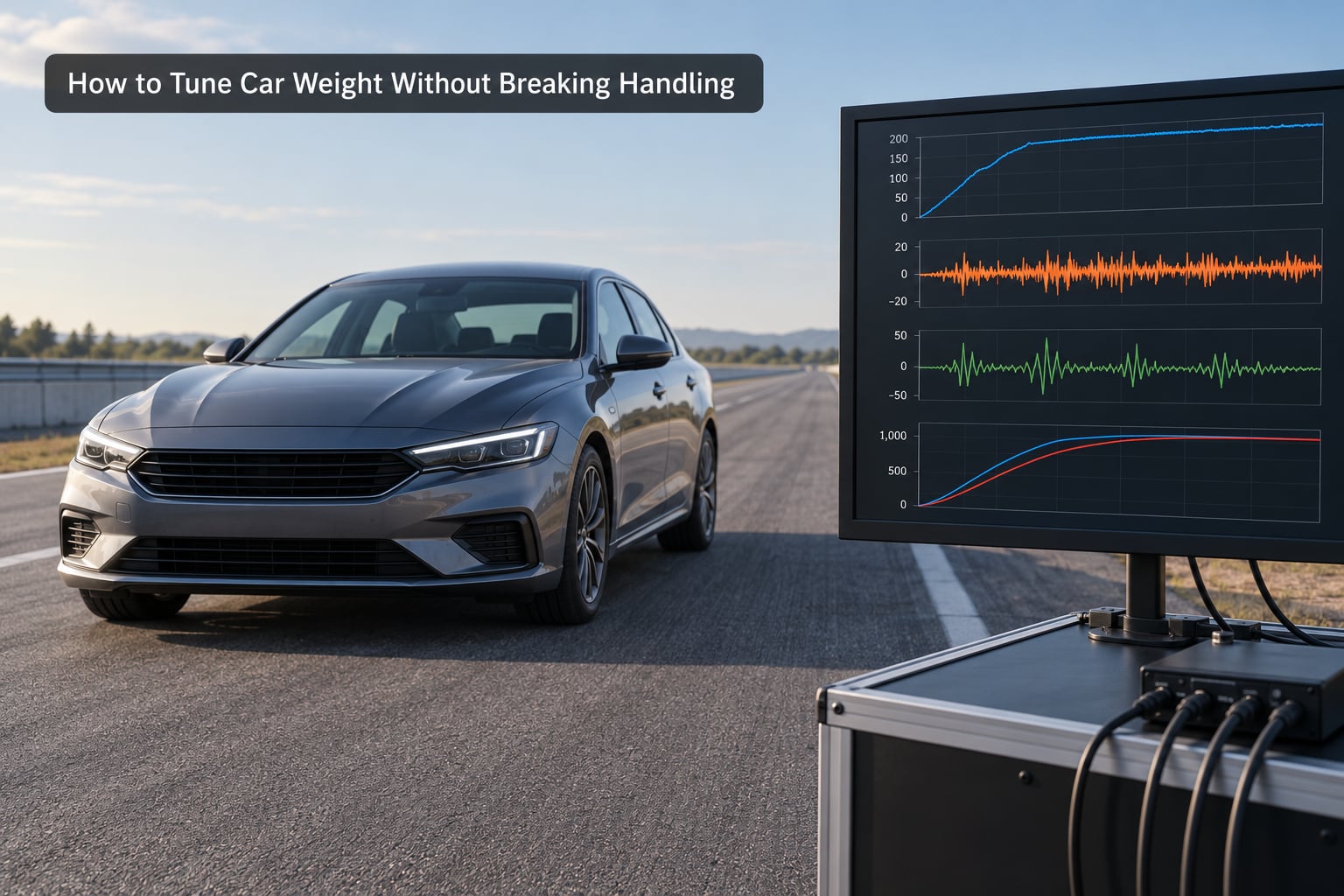
Tune weight in a fixed order, change one variable at a time, and log numbers rather than trusting feel on lap one. The sequence below is the one that survives contact with a real vehicle model.
- Set a realistic baseline mass first. Use the kerb weight of a comparable real car, split into sprung and unsprung. Do this before touching anything else, because every other number depends on it.
- Place the center of mass. Height sets load transfer, and the fore-aft offset sets your weight distribution. A center of gravity around 400 to 550 mm suits a road car; racing and off-road models sit lower.
- Set the inertia tensor to match the mass. Most engines derive it from the collision shape, which is usually wrong once you change mass by hand. PhysX documentation treats the chassis moment of inertia as one of the most important vehicle parameters for exactly this reason, and notes that scaling it down makes a car turn more responsively.
- Rebalance the suspension for the new mass. Springs that were soft enough for 1,200 kg will leave a 1,800 kg car wallowing. Increase spring and damper rates roughly in proportion to mass to preserve ride frequency.
- Adjust brake and drive force to the new mass. Scale both by the same ratio as mass, or accept a slower car and longer stops as a design choice rather than a bug.
- Test repeatably. A standing-start acceleration run, a fixed braking marker, a steady-state skidpad circle and a repeated jump. Record the same numbers each time.
- Re-check the timestep before raising mass further. See the failure mode below.
The reference table of handling parameters
| Parameter | Typical value | What it controls | Effect of increasing it |
|---|---|---|---|
| Mass | 1,000-2,000 kg | Acceleration, braking, impact | Slower, calmer, more load per tire |
| Center of gravity height | 400-550 mm | Load transfer and rollover threshold | More roll, more transfer, higher rollover risk |
| Yaw moment of inertia | Derived from shape | How fast the car rotates | Slower turn-in, more stable |
| Front/rear bias | 55/45 to 60/40 | Traction and understeer balance | More understeer, less traction off the line |
| Wheelbase | 2,400-2,900 mm | Steering feel and stability | Slower response, higher top speed |
| Spring rate | Matched to sprung mass | Ride frequency and roll stiffness | Less roll, harsher ride |
| Anti-roll bar stiffness | Front and rear separately | Load transfer distribution | Front-biased bar sharpens turn-in, adds understeer |
| Downforce | Model-dependent | Grip that scales with speed | More grip and more stability without adding mass |
When experienced modders want more response, the near-universal advice is downforce rather than weight. It raises grip at speed without loading the tires harder at low speed, which is exactly where load sensitivity bites.
Why very heavy vehicles stop working
There is a mass ceiling, and it comes from the integrator rather than the vehicle. Physics engines commonly step at 60 Hz, a frame of about 0.0167 seconds. Suspension is modelled as stiff springs solved over that interval, and as mass rises the stable range of spring stiffness and damping narrows. Beyond a point, the solver diverges: the car oscillates, sinks through the ground or behaves as if weight has become random. Developers on Unreal Engine forums report that vehicles above roughly 10,000 stop operating correctly altogether, and transient tire effects genuinely want kilohertz rates to resolve properly.
The fixes are all in the timestep domain. Run physics at a fixed sub-step, stiffen the suspension in proportion to the mass so the natural frequency stays in a solvable band, and cap maximum mass for gameplay reasons rather than discovering the limit by testing.
Arcade or simulation: when to ignore real mass
Decoupling mass from grip is a legitimate design decision, not an error. If a car needs to hit a top speed on a short straight, spin on command for a drift game, or stay controllable after a collision at any speed, real mass will fight you. The workable compromise keeps the mass value honest for collisions and adds a separate grip scaling that does not follow the 1/load relationship.
Pick one model and be consistent. A handling model that quietly doubles grip at speed so the car feels responsive while claiming real mass numbers in the inspector produces a vehicle that behaves like nothing in the real world.
Five situations where real mass works against you, and what to do instead:
- A drift game. Rotate the car on demand with a yaw impulse rather than waiting for weight transfer to build it.
- A short straight-line racer. Scale the mass-to-power relationship in the vehicle model only, and leave collision mass alone.
- An open-world game with traffic. Keep real collision mass so crashes read correctly, but scale braking and steering response separately.
- A mobile game on a variable framerate. Lower the mass ceiling rather than adding sub-steps you cannot afford.
- A vehicle that must survive low framerates. Reduce mass and increase grip, since a stiff suspension at high mass is the first thing to diverge when the timestep stretches.
How Car Weight Affects Handling in Game Physics in Practice
Take a 1,500 kg car and add 20%, giving 1,800 kg, changing nothing else. Expect acceleration to drop from about 6.7 m/s² to 5.6 m/s² and braking distance from roughly 48 m to 58 m. In a corner, the load split widens from about 68/32 to closer to 73/27 outside-to-inside, so turn-in goes slower and softer and the car needs more steering lock before it starts to rotate.
Body roll grows as well, because the same lateral force acts through a taller effective moment, and the suspension now has more energy to absorb per stroke. On a collision the car shoves a lighter opponent noticeably further. In a jump it lands flat and stops, where the 1,500 kg version would still be settling. Raise the tire friction values to compensate and the result is fast but a car that squats and dives under power, which reads as heavier and worse to drive anyway.
That last point is worth sitting with. Weight is a real physical constraint, not a feel multiplier, so the correct answer is usually to adjust everything downstream of it rather than to keep mass quiet.
Common Weight-Tuning Mistakes
| Mistake | What goes wrong | Fix |
|---|---|---|
| Changing the visual mesh without changing density | Mass is recomputed from geometry and silently shifts | Set mass explicitly; never let the collision hull drive it |
| Adding mass and leaving tire grip alone | Load sensitivity means grip does not keep up; the car feels vague | Raise friction values or add downforce in proportion |
| Moving the center of mass by accident | Load transfer, roll and balance all shift without warning | Log center-of-gravity height and fore-aft offset in every build |
| Mixed units across imports | Grams next to kilograms produce a 1,000-fold error or a car that never moves | Standardise on SI internally; convert at import |
| Judging balance by top speed | Top speed barely changes with mass, so the test proves nothing | Test braking distance, skidpad lateral g and lap time |
| Scaling springs without scaling damping | The car ends up bouncy or overdamped in one axis only | Raise spring and damper rates together with mass |
Frequently Asked Questions
Should I change a vehicle’s mass when I edit its visual model?
Only deliberately. A visual mesh should not drive mass, because collision geometry is an approximation and a wider body kit will change the calculated value without changing anything about the car. Set mass as an explicit parameter and treat the mesh as decoration. If you do want the car to feel heavier, change mass, then rebalance springs, dampers, brake force and tire friction in the same pass.
How do game engines handle vehicle mass differently?
The maths is the same everywhere. What changes is how much of it is exposed and how it is approximated. Dedicated vehicle SDKs such as PhysX and Unreal’s Chaos Wheeled Vehicle Physics expose mass, center-of-mass offset and an inertia tensor directly, and they split the mass into sprung and unsprung portions. General rigid-body engines derive mass from shape and density, which is far less controllable. Both run on a fixed timestep, commonly 60Hz.
What unit system should I use when tuning vehicle physics?
Use kilograms, metres and seconds internally. Newtons, pascals and metres per second squared follow from that, and every equation in vehicle dynamics assumes it. Mixing pounds, feet and slugs is where silent errors come from, because the conversions are non-round and a five percent unit slip looks like a plausible tuning change. Convert on import and on export only.
Does a lighter car always handle better in a racing game?
No. Lighter means faster acceleration, shorter braking and quicker rotation, which suits most racing setups. But low mass also means faster response to inputs, so a very light car can feel nervous and snap into oversteer with no warning. Mid-engine and karting cars prove the point: they are light and still demand deliberate hands. Balance comes from mass distribution and grip, not from being light.
How can I tell whether a handling problem comes from weight?
Log tire load, slip angle, suspension travel and center-of-mass height for a fixed manoeuvre. If the load split is wrong before the car moves, the mass distribution or center-of-gravity placement is wrong. If load is correct but the friction limit is hit early, tire grip values are too low for the mass. If the car oscillates or sinks, you are at the timestep stability limit rather than a tuning problem.
Should mass changes be balanced differently in multiplayer games?
Yes. In single-player you can respec freely; in multiplayer a heavier vehicle that hits harder and corners worse is worth more without costing anything, which breaks competitive balance fast. Compensate with stricter turn radius, longer braking, higher fuel use or a lower top speed. Track the mass-to-grip ratio across every vehicle rather than judging each one in isolation.
Conclusion
Weight is the parameter that connects every other handling variable in a vehicle simulation. It sets how fast the car accelerates, how far it takes to stop, how much load lands on each tire in a corner, how the car rotates, and how hard it hits anything. Get it wrong and nothing else you tune will behave the way the numbers suggest.
Start by setting a realistic mass and a realistic center of mass for a real comparable car, then change one variable at a time. Log tire load and suspension travel against a fixed set of manoeuvres rather than judging on lap feel alone. If you want more grip, add downforce before you add weight — and if you want more response, adjust the inertia tensor before you touch anything else.
For the theory behind the numbers, Race Car Vehicle Dynamics by Milliken and LeFew remains the standard engineering reference, and the PhysX and Unreal vehicle SDK documentation show the same equations as they are actually implemented.