Making a drift setup for a modded car in GTA V comes down to one file: the vehicle’s handling. You back it up, open it in a handling editor, cut rear grip, add steering lock and handbrake force, then export the edit back into the resource that owns the car. On FiveM that resource is a folder inside your server data, and in single-player it sits in your add-on vehicle folder.
Most downloaded cars ship with default handling built for grip, which is why a mod looks great in the showroom and then understeers into every corner or spins the moment you ask for angle. The first tune takes about an hour. Every change after that is two minutes.
Table of Contents
- 1What You Need Before You Start
- 2Step-by-Step: How to Make a Drift Setup for a Modded Car
- 3Step 1: Install and Verify the Modded Car
- 4Step 2: Check the Vehicle’s Handling and Model Name
- 5Step 3: Tune the Handling Values for the Drift Setup
- 6Step 4: Tune Wheels, Steering, and Power
- 7Step 5: Test the Setup in a Safe Location
- 8Common Mistakes That Break a Drift Setup
- 9Frequently Asked Questions
- 10Can I make any modded GTA V car drift?
- 11What is the best handling editor for a modded car in GTA V?
- 12Why does my modded car not drift after changing handling values?
- 13Should I edit handling for FiveM or single-player GTA V separately?
- 14How do I stop a modded car from spinning out immediately?
- 15Can I use a drift setup with a vehicle add-on that has custom parts?
- 16Conclusion
What You Need Before You Start
Six things, and only two of them are tools you might not already have running.
- A GTA V PC install with mods turned on. FiveM handles this for you. For single-player you need the correct Script Hook and a mods folder set up at
x64inside your GTA V directory. - A mod install tool. OpenIV is the standard choice because it writes files into the right game directories instead of the folder you downloaded to. A text editor is enough if you already know the path.
- A handling editor. Extended Handling Editor reads and writes the same handling file the game loads, shows every value with a label, and lets you undo. A plain text editor also works, just with more guessing.
- A way to see spawn names. A trainer menu in single-player, or a vehicle-spawn command or script on your server. You cannot tune what you cannot name.
- The add-on files themselves. The model file, the
.yftand.ytdtexture files, and any extra data files the author included. Read the download notes, because a car that needs a tuning resource will say so. - A backup and a test route. A copy of the original handling file, and somewhere wide, flat and empty to drive.
Each of these has to match your environment. Single-player edits and server edits are stored in completely different places, and a handling editor open on the single-player copy will not change what your FiveM players get.
Step-by-Step: How to Make a Drift Setup for a Modded Car
Step 1: Install and Verify the Modded Car
Install the add-on before you tune anything, so you know the handling file you are editing is the one the game actually loads.
Open the archive and check what came inside. A car add-on normally has the model file, one or two texture files, and sometimes a folder with tuning data for that specific model. If the archive has a readme, read it. Authors list required resources there, and skipping one is the usual reason a car spawns invisible.
Install through OpenIV, choosing the game folder when it asks. Then start the game or restart the server and confirm the car appears in your trainer or spawns by name. If it does not appear, stop there and fix the install. Tuning an unloaded car is wasted time.
Before touching a single value, copy the vehicle’s existing handling file somewhere outside the game folders. That copy is your undo button, and you will use it more than you expect.
Step 2: Check the Vehicle’s Handling and Model Name
Spawn the car and find out two things: its exact model name and which handling block it loads.
The model name is the file name the game uses, not the display name from the download page. Spawn it through your trainer or a server command, then read the name it reports. Write it down exactly, including capitals. Handling files key off that name, and a near-miss silently loads the wrong entry or none at all.
Open the handling file and look for the block matching that name. If the car has custom tuning data, you will see separate values in there rather than a shared default, which tells you the author already tried to tune it. If there is no entry for your model, the car is running on a default handling block and you need to add one before any of your edits will matter.
Make a note of which file is the live one. On FiveM, a car resource can contain its own handling file, and another resource can still override it at runtime. Find out which of the two is winning before you start changing numbers.
Step 3: Tune the Handling Values for the Drift Setup
A drift car is a car that breaks rear traction predictably and holds the slide, so most of the work is in the grip, mass and suspension values rather than the engine.
Change a small group of values, save, drive, and only then decide what to change next. Editing twenty fields at once tells you nothing about which one helped.
Use this as your starting reference. The ranges are conservative on purpose.
| Setting | What it controls | Drift range to try | Symptom it fixes |
|---|---|---|---|
| Strut compression / tension stiffness | How fast weight moves to each corner | Rear softer than front | Car is nervous on entry and flicks on transitions |
| Anti-roll stiffness | Roll resistance across an axle | Lower at the rear | Rear steps out too fast to catch |
| Friction (tyre grip) | Maximum grip the tyres generate | Lower rear than front | Car grips and refuses to initiate |
| Downforce | Grip added with speed | Remove or set very low | Slide dies the faster you go |
| Steering lock | Maximum steering angle | Raise above the default | Cannot hold a big angle without spinning |
| Handbrake force | Pull from the handbrake command | Raise well above the default | Cannot initiate without clipping a wall |
| Mass and centre of mass | Weight and where it sits | Move mass slightly rearward | Car feels like it wants to push wide |
| Differential lock | How the rear axle splits torque | Raise toward full lock | Rear wheels spin in a straight line only |
Save each group before you test it. If the car becomes undriveable, you want a file to go back to rather than a memory of what you changed.
Step 4: Tune Wheels, Steering, and Power
This is the step that turns a car that slides into a car you can drive sideways for more than two seconds.
Wheel grip and traction settings decide how much the rear end fights you once it is loose. Small rear-wheel grip values give you an easy, forgiving slide. Large ones make the car snap back into line and refuse to stay sideways.
Steering lock decides how much correction you have. Add a modest amount first and drive on a keyboard before adding more, because a large lock on keyboard makes the car hard to aim. Turn it up gradually until you can hold your chosen angle without constant correction.
Power delivery matters more than raw power. A car with roughly 200 horsepower is enough for game drifting, and community tunes usually lean on steering angle and balance rather than more engine. If your car spins up on every corner entry, take some torque out before you blame the grip settings. Set the differential to allow some slip so both rear wheels keep turning during a slide rather than one lighting up.
If the add-on has custom parts, wide rims or a lowered body, they change grip and roll behaviour without changing any number in the file. Expect to readjust the friction and anti-roll values after adding them.
Step 5: Test the Setup in a Safe Location
Test on the same short loop every time, because you can only compare results from an identical route.
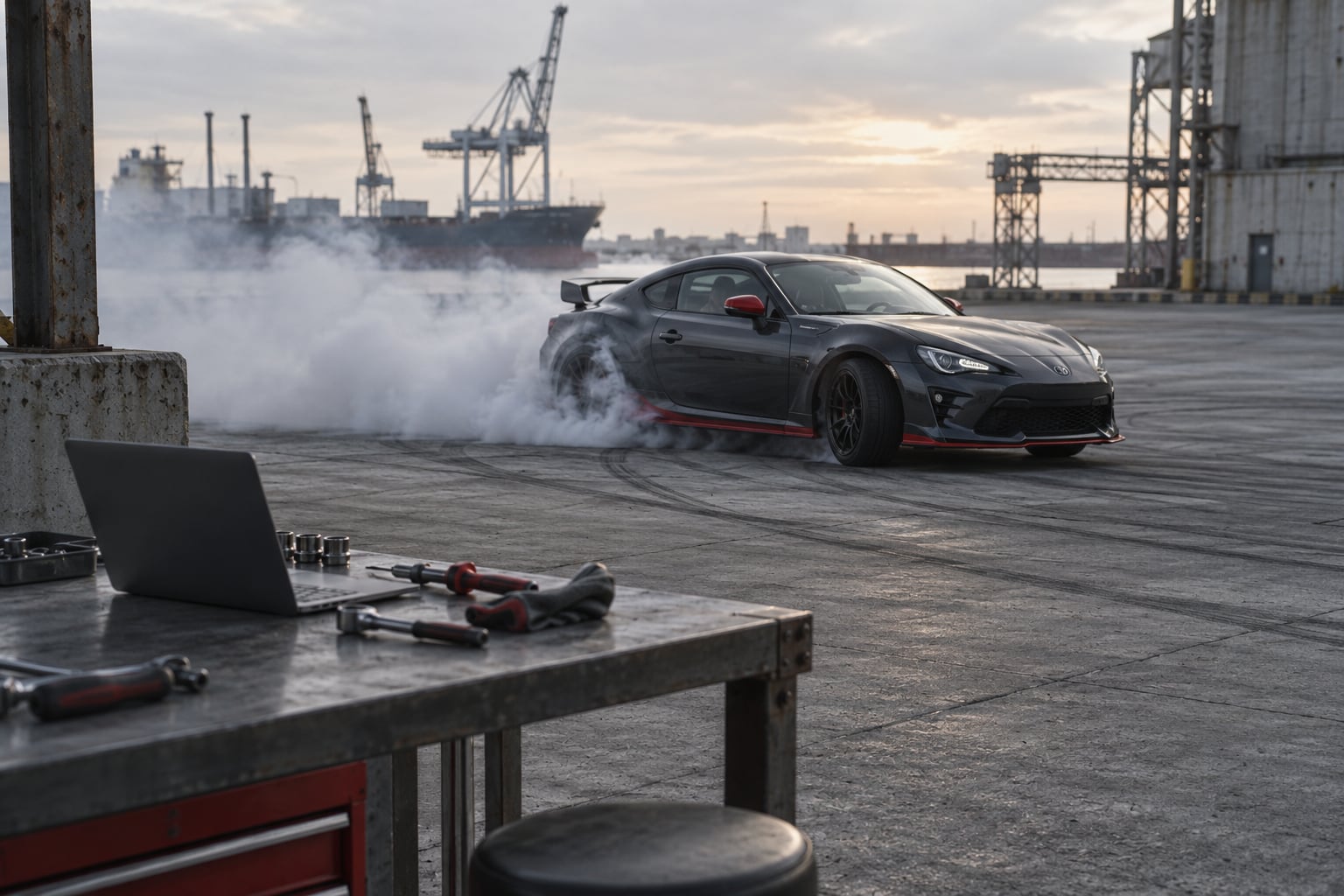
An empty industrial yard or a wide car park at night works well. Concrete gives predictable grip, and nobody spawns on you mid-test.
- Drive slowly in a circle at low speed and confirm nothing snaps or slides unexpectedly.
- From about 30 km/h, flick the car into a turn and see whether the rear steps out on throttle alone.
- Apply the handbrake at moderate speed and check that the rear breaks away without instantly spinning.
- Hold an angle and count how long it lasts before the car straightens itself or spins.
- Do a transition, which is a left slide into a right slide, and note whether the car snaps when you swap direction. This is where most setups feel broken.
- Write down what happened before you change anything. One value at a time is the whole discipline.
Run the loop twice on the first session. The second lap usually feels different from the first because the tyres and the suspension have settled, and the difference tells you whether a change helped or you just got used to the car.
Common Mistakes That Break a Drift Setup
The car is missing or invisible after install. A texture or model file did not land, or a required tuning resource is absent. Reinstall through OpenIV and check the author’s readme for extra dependencies.
Your handling edits do nothing at all. Almost always a name mismatch or the wrong file. Confirm the exact model name, then confirm the file you edited is the one being loaded, not a copy another resource overrides.
The car spins out the instant it breaks traction. Rear grip and anti-roll values are too high, or the mass sits too far forward. Drop rear friction slightly and soften the rear anti-roll before touching anything else.
The car will not drift no matter what you do. Downforce and high-speed grip are holding it. Remove downforce, lower rear friction further, and raise the handbrake force so initiation is possible at all.
The car feels twitchy on transitions. The most common complaint in drift forums. The rear is snapping between grip states. Add a little rear grip or stiffen the rear anti-roll, and reduce steering lock slightly.
Your tune reverts every restart. You edited a live copy inside the game folder, or you changed values in the handling editor without exporting them into the resource that owns the car. Runtime edits are temporary until exported.
It drifts on the drift server but not in single-player. A drift script on the server is deleting grip and fighting the handling you set. That script sets its own values, so your file is being overridden. Test the car on a plain server without the script to check your own tune.
One habit prevents most of these: after every successful drive, copy the handling file again and name it with the date. You end up with a short list of known-good tunes instead of one current file you cannot go back to.
Frequently Asked Questions
Can I make any modded GTA V car drift?
Almost any car can be turned into a drift car, because drifting is a handling characteristic rather than a part. If the add-on has its own tuning data you can edit, start there. If it runs on a shared default block, add an entry for that model name first. Heavy SUVs and cars with very low power need more work than a light coupe.
What is the best handling editor for a modded car in GTA V?
Extended Handling Editor is the easiest choice because it labels every value, shows the effect of a change, and can undo a mistake. A plain text editor works too and is what you fall back on when a value will not save cleanly. Whatever you use, keep the exported file, not just the live one, because live edits disappear on restart.
Why does my modded car not drift after changing handling values?
Check three things in order: the model name matches the handling entry exactly, the file you edited is the one the resource loads, and no script is overriding the values at runtime. If all three look right, the values themselves are probably still too grippy. Lower the rear friction further and remove downforce, then drive slowly before judging it.
Should I edit handling for FiveM or single-player GTA V separately?
Yes, they are separate files in separate places. Server vehicles live in resources inside your FiveM data folder, and single-player add-ons live in your mod folder on disk. The same car can therefore behave differently on your own game and on a server. Back both up separately and only change the side you actually play on.
How do I stop a modded car from spinning out immediately?
Take grip out of the rear and give the car room to slide instead of snapping. Lower the rear friction a little, soften the rear anti-roll, and reduce torque if it lights up the tyres on entry. Raise the handbrake force so you can initiate gently. Then test at low speed, because a car that spins at 40 km/h will also spin at 80.
Can I use a drift setup with a vehicle add-on that has custom parts?
Yes, and you will need a second pass. Custom rims, wide wheels and a lowered body change grip and roll behaviour without changing a single number in the handling file. Install the parts, drive the same test loop, then readjust friction and anti-roll values to match. Add the parts before you tune whenever you can.
Conclusion
How to make a drift setup for a modded car is a five-step loop: install the add-on and confirm it loads, write down the exact model name, back up the handling file, change a small group of values, then drive the same test loop and write down what happened.
Start conservative. Lower rear grip a little, add modest steering lock, raise the handbrake force, and only then decide what the car needs. If you keep one backup file and change one variable per test, you will always know how to get back to a car that drives.