To find myths and urban legends in game worlds, treat every rumour like an unverified claim: find where it started, check whether the game itself supports it, then reproduce the steps yourself and write down what happened. Most hunts take an hour of preparation and end with a verdict, not a secret. The method below is the one that saves you the forty-hour grind for nothing that veteran myth hunters regret.
A gaming urban legend is a story that travels through gaming communities as if it described something real in a game — a hidden character, a cursed cartridge, a ghost that spawns at night. Some are genuine discoveries that stayed quiet for years. Most are jokes, mistranslations or magazine pranks that got copied until everyone treated them as fact.
That gap is the whole reason this method exists. Everything below is built around one habit: separate what the game shows you from what people say about the game.
Table of Contents
- 1What You Need
- 2Step-by-Step: How to Find Myths and Urban Legends in Game Worlds
- 31. How to Find Myths and Urban Legends: Start With Reliable Clues
- 42. Map Every Location the Rumour Mentions
- 53. Ask NPCs and Read What They Carry
- 64. Check Quests, Archives, and Older References
- 75. Test the Claim and Log the Result
- 86. Compare Claims Across Game Versions
- 97. Record and Share Confirmed Discoveries
- 108. Common Mistakes That Waste Whole Weekends
- 119. Tips for Faster Myth Hunting
- 12Frequently Asked Questions
- 13How can you spot an urban legend?
- 14How do I know if a game secret is real?
- 15How do I find hidden easter eggs in a game?
- 16What is the Polybius arcade game?
- 17Why do video game myths keep spreading?
- 18Conclusion
What You Need
You need less gear than most people assume. Five things cover every investigation.
- A current game version. Know which patch, edition and platform you are on. Legends break constantly when a patch changes a model, a trigger or a map.
- Full map access. Completion percentage, a region key, or a fast-travel list. Most false leads die because the player never reached the right side of the map.
- A written log. A phone note or text file. One line per claim: what was alleged, where the claim came from, what you tried, what happened.
- Screenshot capture. Not for proof of heroism. For the details people argue about — a prop, a sign, a UI string.
- Access to community archives. A wiki, a forum archive, an old walkthrough database. Search them for the original post, not just the newest retelling.
That last one matters more than the rest. Nine times out of ten the claim you read was copied from a source years older, and the original tells you whether it was ever a joke.
Step-by-Step: How to Find Myths and Urban Legends in Game Worlds
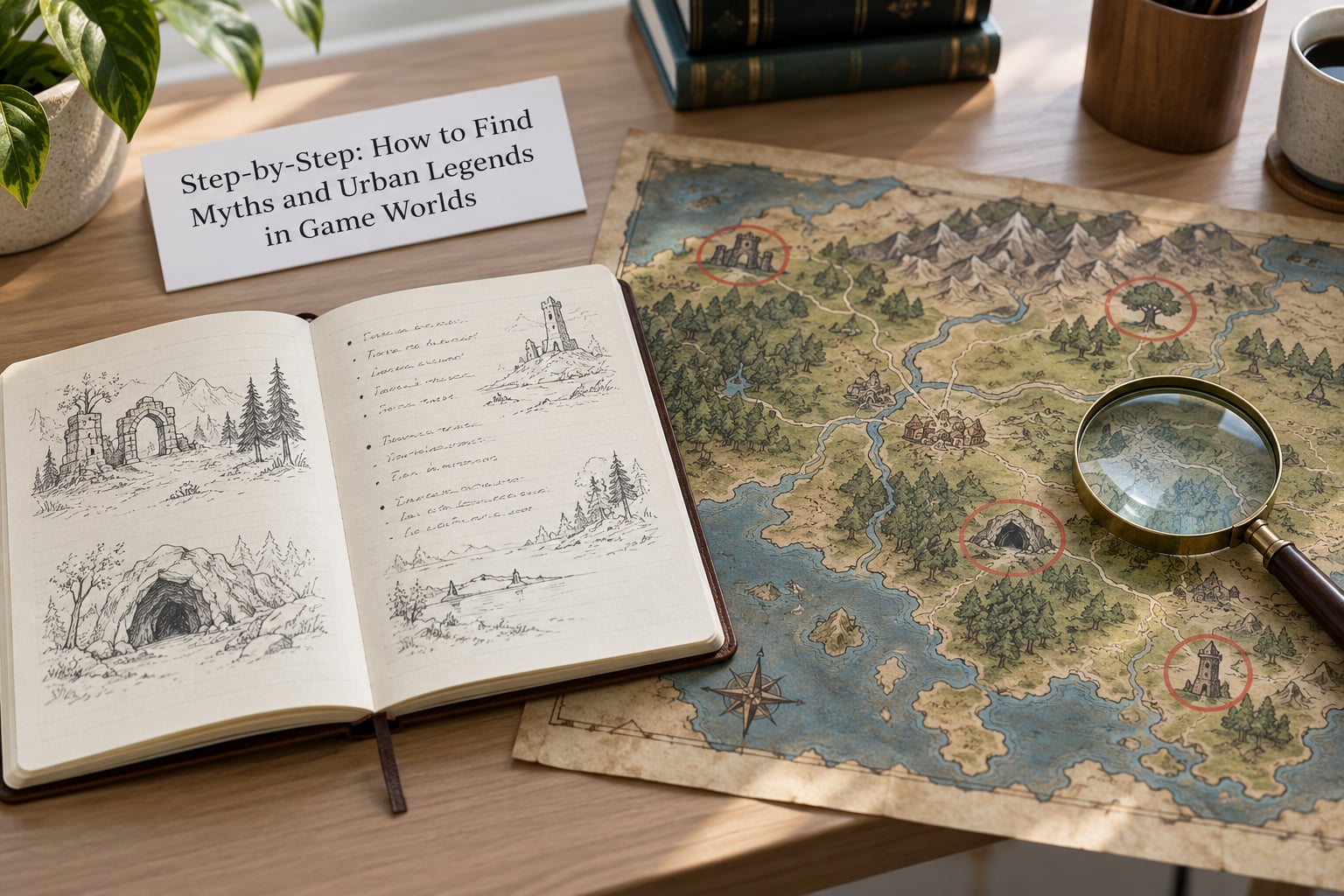
Seven steps take a rumour from a sentence someone said to a verdict you can defend. Work them in order and you will not grind a 1998 forum joke for a weekend.
1. How to Find Myths and Urban Legends: Start With Reliable Clues
Write the claim in one sentence, then rank what supports it. Dialogue you heard yourself, an item description in the inventory, a change in the world between two visits and an official patch note are evidence. A friend mentioning it, a video thumbnail and a wiki line with no citation are not.
Specific beats loud. “A second swordsman appears on the bridge at night if you wait” is testable. “The bridge is haunted” gives you nothing to do.
2. Map Every Location the Rumour Mentions
List each place named in the claim and cross it against your map, including areas you have no reason to enter. Legends cluster in gated corridors, underwater rooms and the last building in a region, because those are the spots nobody bothers with.
Then vary the conditions. Return at night, in rain, with a different weapon equipped or after completing a nearby quest. Many claims are true only under conditions the original poster never mentioned, and that omission is usually where the lie was hiding.
3. Ask NPCs and Read What They Carry
Dialogue trees are the cheapest evidence in any game. Ask every villager about the topic, then ask again after the quest that touches that area changes, because repeat conversations often swap lines and add hints that were not there before.
Read the objects too. Notes, plaques, books and item descriptions are where developers put jokes and hints in plain sight. If a rumour says a name is hidden in the game, search that name in your save, your inventory text and the patch notes before you start exploring.
4. Check Quests, Archives, and Older References
Quest text is written to be reread. Objectives often describe conditions the mechanic does not mention, and a completed quest can permanently alter a location so a later visit shows something new.
Community archives are the other half. Fan wikis, old forum threads and walkthrough databases from previous releases will tell you what changed. If a secret existed in an earlier build and vanished in a patch, the archive is how you find that out. Treat a fan page as a lead until it cites something you can check yourself.
5. Test the Claim and Log the Result
Run the test properly: write the original claim first, then the conditions it requires, then what you did, then what you observed. Keep it in one table row so you can compare later attempts.
Then label it honestly. Confirmed means you reproduced it twice. Disproven means you followed every stated condition and nothing happened. Unresolved means a condition could not be met — a required item, a difficulty setting, a version you do not own. That third label is more common than people admit, and it is the honest one.
A word on time. Set a limit before you start — a couple of hours for a single test. The most expensive stories in this genre are the ones where someone spent a hundred hours on a mechanic that was never wired up.
6. Compare Claims Across Game Versions
Before you call anything confirmed, note the platform, edition, patch, DLC and difficulty, plus anything random such as encounters or spawns. A secret that works only on the original release and only without DLC is still real, it just has conditions.
Re-test after major updates. Studios remove references, rename items and change triggers, and a legend can quietly stop working without anyone announcing it. Check the patch notes for removals before assuming you did something wrong.
7. Record and Share Confirmed Discoveries
Save screenshots with the location, character state and version visible, then write reproduction steps short enough that a stranger can follow them. Both, not one: a screenshot with no conditions cannot be checked, and conditions with no screenshot sound invented.
Add a spoiler warning for plot details, and a content note for the disturbing material — the haunted cartridge stories, the found-game horror entries, the glitch-pokemon threads. Most forums ask for this and readers appreciate it more than they say so. Keep interpretation separate from fact, and say plainly whether you saw it or inferred it.
8. Common Mistakes That Waste Whole Weekends
- Treating a forum rumour as fact. The original post is usually four years old and was never verified.
- Ignoring version differences. The most common cause of a failed reproduction.
- Missing context. A cursed item on a modded install is not a base-game secret.
- Repeating unsourced claims. Reposting the legend adds a false citation that later hunters trust.
- Confusing flavour text with a feature. A grim item description is writing, not a mechanic.
9. Tips for Faster Myth Hunting
Keep a running rumour list and stop researching one at a time. Check your map again after every update, since patch notes often name the area that changed. Change one variable per attempt — time, weather, equipment, quest state — so you know which one mattered.
Ask what a developer would have needed to build. If a claim requires a frame-perfect input during a two-frame window on a specific date, the odds are poor, and that reasoning alone can save you a weekend.
Frequently Asked Questions
How can you spot an urban legend?
An urban legend has a story but no evidence attached to it. There is no date on the post, no version listed, and no reproduction steps anyone can follow. The claim describes a feeling or a scare rather than a condition you can test. When three independent sources all trace back to the same old post or magazine prank, it is copy-paste propagation, not confirmation. If you cannot state the trigger in one sentence, you have a rumour, not a lead.
How do I know if a game secret is real?
You know when you can reproduce it yourself, twice, and someone else reproduces it on the same game version. Record the platform, edition, patch and difficulty along with the exact steps, because a secret with conditions is still real. If you followed every stated requirement and nothing happened, the claim is disproven rather than wrong, and that is worth writing down too. Unresolved means a condition you could not meet.
How do I find hidden easter eggs in a game?
Start with dialogue, item descriptions and notes, because developers put most references in text a player reads without trying. Then sweep the map for gated and forgotten areas, and revisit each one at night, in different weather and after nearby quests change. Search old wiki pages and previous-release walkthroughs for anything that no longer appears in your version. Finally, read patch notes, which sometimes name the area holding a reference.
What is the Polybius arcade game?
Polybius is the name attached to a rumour about an arcade cabinet that supposedly records everything a player does and deletes itself after a set time. No copy has ever been located and no arcade operator has confirmed one, which is why it stays in the unresolved column rather than the false one. The story works better than the evidence. It is also a good training example: a claim nobody can test should be filed as unproven, not repeated as fact.
Why do video game myths keep spreading?
They spread because a false claim is easier to share than a correction, and because the story is more fun than the truth. Once a rumour has a memorable image, it survives disproof, and players keep retelling it while believing they are debunking it. Forums show the same pattern: the mythical sightings people remember were social experiments or deliberate pranks. Labelling your verdict as confirmed, disproven or unresolved is the smallest useful contribution.
Conclusion
Pick one rumour tonight and do the boring part first: write down the claim in a single sentence, find the oldest source you can, and note which game version it was written about. Then check the location, the NPC dialogue and the item text before you spend an evening grinding. When you are done, label it confirmed, disproven or unresolved and write down what would settle the case. That one habit is what separates finding myths and urban legends in game worlds from chasing them.