To practice drifting in open world games, pick a low-power rear-wheel-drive car, find a wide empty area, then run one repeatable loop: break traction, apply opposite lock, hold the throttle steady and straighten out. Twenty focused minutes in a parking lot teaches more than an hour of random sliding in traffic.
That loop is the whole method. Everything else is detail about which button to press and how gently.
Drifting in a game means deliberately letting the rear tyres lose grip through a corner so the car slides sideways, then holding that slide with opposite lock and throttle. You are usually not going faster. You are buying drift score, boost, or just the muscle memory for a drift event later.
Open worlds are unusually good training grounds for it. There are no lap counts and no track limits, so you can run the same corner two hundred times without stopping. Forum threads about drifting are full of beginners who learned on a wheel, in Forza or in BeamNG, in an empty car park rather than on a circuit.
This guide covers the four stages of the loop, the settings you have to change before any of it works, a short daily routine, and a symptom-to-fix list for the failure everybody hits: the drift lasts about two seconds and then the car straightens out.
Table of Contents
- 1What You Need
- 2Step-by-Step
- 3Choose a forgiving practice vehicle
- 4Find a large, open practice area
- 5Set up the controls and assists
- 6Learn to start a clean slide
- 7Hold the angle with throttle and countersteer
- 8Build speed and angle gradually
- 9Practice transitions and figure-eight drifts
- 10Repeat with a consistency target
- 11Common Mistakes
- 12Drift ends after about two seconds
- 13Car spins into full 360s
- 14Car will not drift at all
- 15Slides off the road into scenery
- 16Drift feels too slow and the score is poor
- 17Controller drifts snap into spins
- 18Wheel goes slack mid-drift
- 19Keyboard drifting feels impossible
- 20Frequently Asked Questions
- 21What is the best open world game to practice drifting in?
- 22Why does my drift end almost immediately?
- 23Do I need a wheel to drift well?
- 24Should I turn off traction control and stability control?
- 25What is the easiest drift car for a beginner?
- 26Is 300 horsepower enough to drift?
- 27Conclusion
What You Need
You need four things, and only one of them costs anything: a car, an input device, space, and a settings change.
A car that forgives mistakes. Rear-wheel drive, modest power, light on its feet. A car with 300 horsepower and a low kerb weight will drift if you can keep it tidy. Anything heavier or grippier fights you the whole way, and you will spend your session fighting the car instead of learning the inputs.
An input device you can be precise with. A wheel gives you analogue throttle and analogue lock, which is the easiest way to hold an angle. A controller works fine, and plenty of players learn on one, but the throttle is a spring-loaded trigger rather than a pedal. Keyboard is the hardest, because throttle is usually on/off. None of the three is wrong. Each needs a slightly different rhythm.
Space with no consequences. Walls, civilian traffic and lamp posts turn a learning attempt into a repair bill. Empty car park, wide industrial estate, a quiet stretch of road, or a game mode that empties the traffic are all fine. If your game has photo mode or a replay, use it to watch your own angles rather than guessing from memory.
Assists switched off. This is where most beginners get stuck, and they rarely suspect it. Traction control cuts throttle the instant the rear wheels slip, which cancels the drift before you feel it. Stability control does the same with braking. ABS is a separate setting and mostly matters at initiation. In most open world racing games with a drift scoring system, you turn both of the first ones off in the assists menu before you start.
One honest note about hardware: players who pick up a Logitech G29 report that the wrong force feedback setup leaves the wheel numb and clipped, which makes drifts impossible to feel. Get the wheel turning and the force feedback working at low settings first. You can raise it later.
Step-by-Step
Learning how to practice drifting in open world games works better as a staged routine than as one long freeform session. Each stage below has an action and a success signal. Do not move on until you can hit the signal twice in a row.
Choose a forgiving practice vehicle
Rear-wheel drive, low to mid power, light, and nothing too grippy. Purpose-built drift cars are the easiest starting point because their steering angle and power delivery are set up for exactly this, which is why Formula Drift cars come up so often in beginner advice in the Forza Horizon community.
Aim for something you can reach and hold at a steady speed without downshifting constantly. If you are fighting the gearbox more than the steering, the car is wrong.
It worked when: you can hold the throttle at a fixed level for three seconds and the car stays roughly where you point it.
Find a large, open practice area
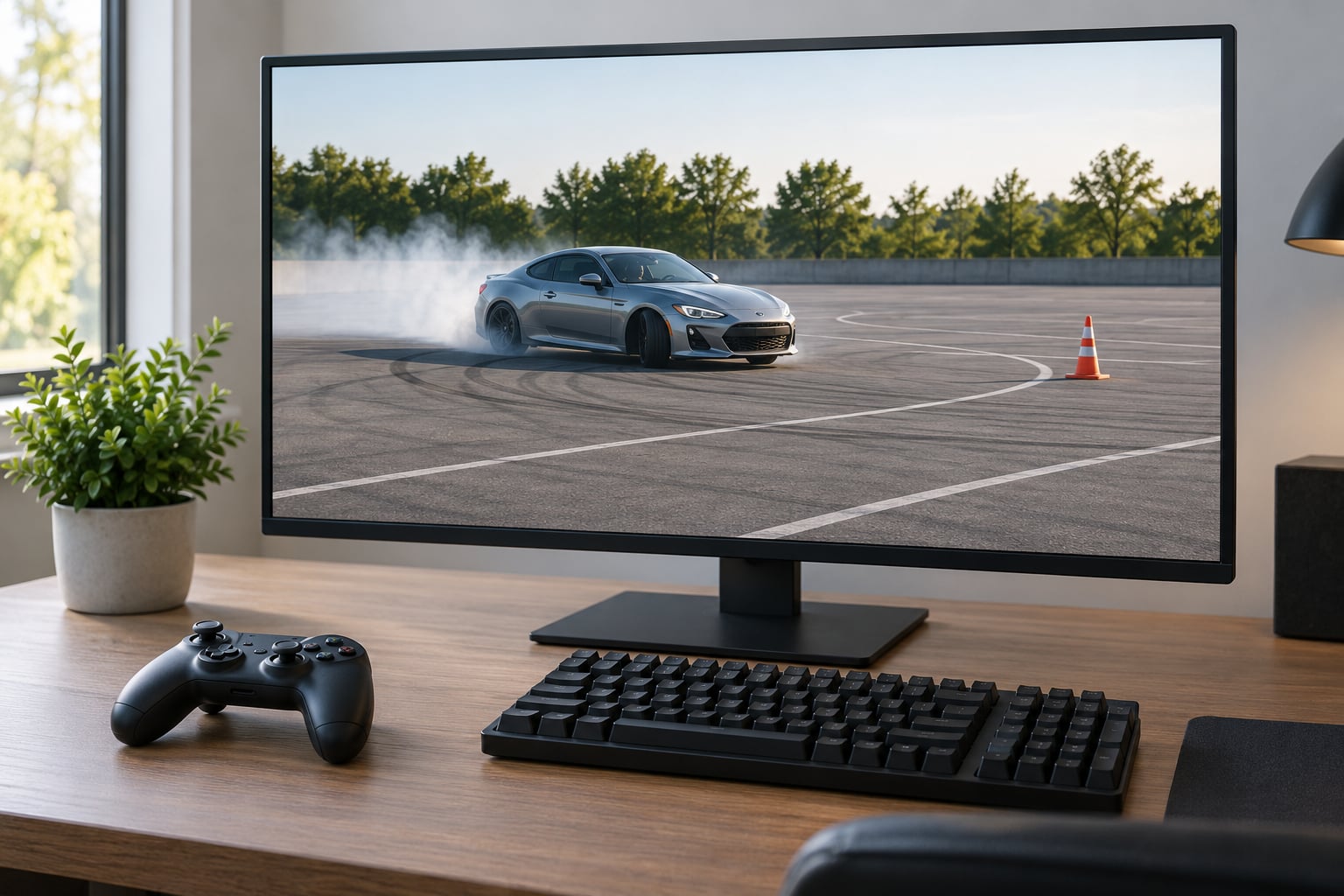
Empty flat ground beats a twisty road every time. You want room to accelerate, turn, stop, and reset without reversing or hitting anything. A car park, a skid pad, a rooftop in a game that allows it, or an industrial area in a sandbox works.
Mark your start point mentally, or use the game’s photo mode to snap the spot so you can return to the identical line every run. Same line, every time, is what turns practice into progress.
It worked when: you can spin the car fully around twice and still have space left.
Set up the controls and assists
Menu names vary by game, but the settings you are hunting for are usually in an assists, driving or handling tab. Exact locations change between releases, so look for the concept rather than a fixed menu path.
- Traction control: off. This is the one that silently kills drifts.
- Stability control: off. Same reason, different name in different games.
- ABS: off for initiation. A locked front wheel stops the car rotating into the slide. Some players keep it on until they can initiate consistently, then switch it off.
- Transmission: manual where available. Manual lets you hold a gear at a fixed speed instead of the game shifting mid-slide. Automatic is fine for the first few sessions.
- Steering lock: as high as the car allows. You need the opposite lock available to catch a slide.
- Controller deadzone: near zero. A default deadzone eats small opposite-lock corrections.
- Wheel: power steering assist low or off, so you feel the front tyres rather than the assist motor.
Simulation players put it plainly: with traction control and stability control on, the car handles like it is on rails and will not drift at all. That is the setting, not your technique.
It worked when: you lift the throttle mid-corner and the rear steps out instead of gripping.
Learn to start a clean slide
Rolling speed first. Get the car moving in a straight line, roughly third gear, and pick up just enough throttle that the rear is light.
Then break traction. There are four ways and they are not equal.
- Handbrake pull. Easiest to learn and works in every game. Steer into the corner, stab the handbrake for a moment, then release. The rear steps out and the car rotates.
- Brake tap. A short stab of the brake at the corner entry. More subtle than the handbrake and it keeps you moving, which is what you want for longer corners.
- Clutch kick. Drop the clutch at higher revs on a manual transmission. Needs a manual gearbox and it is a later-stage technique.
- Feint. Turn in, then snap the wheel the other way before turning back in. Starts the slide without killing any speed, and it is the one that matters for scored events.
Apply opposite lock the moment the car rotates. This is the single habit that separates people who drift from people who spin, and it comes up in every guide ever written about this. Do not wait to see the slide. React to the rotation.
It worked when: the car goes sideways and keeps travelling forward, rather than pirouetting.
Hold the angle with throttle and countersteer
Once you are sideways, two things are happening at once and you are balancing both.
Throttle holds the slide. Rear tyres that have stopped spinning regain grip and the car straightens out. That is the whole reason a drift dies after two seconds: the throttle comes off the instant the car slides. Keep it open, roughly 60 to 80 percent on a beginner car, and make small changes rather than pumping it.
Opposite lock keeps the car pointed where you want it. Too little and the back steps past the nose into a spin. Too much and the car snaps straight and unwinds. You are looking for the amount of lock where the car would hold this angle indefinitely if you touched nothing, and then backing off a touch from there.
If the car starts to rotate faster, add lock. If it starts to straighten, add throttle and reduce lock. That is the feedback loop, and it is the whole skill.
One thing that confuses wheel users: a slack wheel mid-drift usually means the front tyres have let go as well as the rear, not that something broke. Reduce lock slightly and lift a touch.
It worked when: you hold a steady angle for more than five seconds without correcting more than twice.
Build speed and angle gradually
Once a basic slide survives, add one variable at a time. Increase entry speed, or hold a larger angle, or hold the same angle for longer. Not all three, and never all three on the same run.
Keep repetitions short. Twenty clean five-second drifts teach more than two long ones, because a long messy drift teaches you nothing about where it went wrong. Stop the run when it stops being clean.
Tire smoke is not success. A slide at 15 degrees with clean lines and a tidy exit scores better than a wild 45-degree spin, and it teaches you more.
It worked when: you can hold a bigger angle and still exit forward under control.
Practice transitions and figure-eight drifts
A sustained corner is the easy part. Transitions are where it gets interesting, because you have to unload the first slide and load the second without straightening fully.
To change direction: reduce lock slightly, bring the throttle down a touch, let the angle shrink to almost nothing, then steer the new way, reapply opposite lock and bring the throttle back up. Doing that left to right without the car settling in between is a figure-eight drift, and it is the drill that makes the technique automatic.
Run it on a big flat area with generous spacing. Then shrink the figure-eight until the car nearly touches the ends, which forces the angle to stay high.
It worked when: you can change direction three times in a row without the car straightening out between the switches.
Repeat with a consistency target
This is what turns play into practice. Pick a corner and track four numbers per run: entry speed, maximum angle, exit speed, and whether you spun.
Write them on paper or keep a note on your phone. Ten runs takes five minutes and gives you a record instead of a memory, and the record is what shows you which variable is actually holding you back.
Most sessions, the answer is consistency rather than technique. If run four was better than run one, you are learning. Once your numbers stop moving, push one variable: more speed, more angle, or a longer hold.
It worked when: your worst run of ten is close to your best run of ten.
Common Mistakes
These are the failures beginners report most often, and almost all of them have a settings cause or a single input habit behind them.
The big one is lifting off the throttle. The second is over-correcting with lock. The third is leaving assists on without knowing it. Each symptom below is paired with its likely cause and the correction that actually fixes it.
Drift ends after about two seconds
Cause: the throttle came off the moment the car slid, so the rear tyres regained grip. Fix: hold the throttle steady at 60 to 80 percent through the slide and make small corrections only.
Car spins into full 360s
Cause: over-countersteering, or lifting mid-slide. Fix: reduce lock slightly when the rotation speeds up, and add throttle back before the spin completes.
Car will not drift at all
Cause: traction control or stability control is still enabled. Fix: turn both off in the assists or driving settings menu, then re-test the same corner.
Slides off the road into scenery
Cause: practising in a live open world with traffic and walls. Fix: move to an empty car park, an industrial area, or a mode with traffic disabled.
Drift feels too slow and the score is poor
Cause: excess angle with no exit speed, or a handbrake initiation that kills momentum. Fix: reduce the angle and raise exit speed, and initiate with a feint instead of a long handbrake pull.
Controller drifts snap into spins
Cause: trigger travel is spring-loaded, so throttle changes arrive as sudden steps. Fix: use the upper range of the trigger, soften inputs with the stick, and drop the deadzone to near zero.
Wheel goes slack mid-drift
Cause: the front tyres have also lost grip, which is not a fault with the wheel. Fix: ease off lock a little and reduce throttle briefly to let the fronts bite.
Keyboard drifting feels impossible
Cause: throttle is mapped to a digital key, so it is fully on or fully off. Fix: use the highest gear you can hold and simulate throttle with short pulses, or bind an analog axis if the game supports it.
Two more habits worth breaking early. Do not practise in traffic, because the penalties cost more attention than the run itself. And do not chase one huge drift for an hour; short clean repetitions build the reflex, and the reflex is the thing that survives when a drift event starts at full speed.
Frequently Asked Questions
What is the best open world game to practice drifting in?
For forgiving drift physics, Forza Horizon is the usual answer, because it produces long controllable slides and its scoring rewards them. BeamNG.drive is the most rewarding sandbox but noticeably harder, since little is smoothed over. Stick to an empty area in whichever one you own rather than chasing a specific title; the practice loop is the same in all of them.
Why does my drift end almost immediately?
Almost always the throttle. Beginners lift the instant the car slides, which lets the rear tyres regain grip and the car straightens out within a couple of seconds. Hold the throttle open through the slide at a steady level and only make small corrections. The second most common cause is traction control, which cuts the throttle for you the moment the rear slips.
Do I need a wheel to drift well?
No. Plenty of players learn on a controller and score well in drift events. A wheel makes it easier because throttle and lock are analogue, so you can hold a precise angle. On a controller, use the upper range of the trigger for throttle and drop the stick deadzone to near zero so small countersteer corrections register.
Should I turn off traction control and stability control?
Yes, both, if you want sustained slides. Traction control reduces throttle when the rear wheels slip and stability control brakes to correct it, so together they cancel the drift before it develops. ABS is a separate choice: turn it off when you are initiating slides by braking, and keep it on only while you are still learning that step.
What is the easiest drift car for a beginner?
Something rear-wheel drive, light, and low to mid power. Purpose-built drift cars are the easiest because their steering lock and power delivery are set up for slides, which is why Formula Drift cars are frequently recommended to new players in Forza Horizon. Avoid heavy or high-grip cars; they will not rotate on throttle and make every mistake expensive.
Is 300 horsepower enough to drift?
Yes, and more is not better for learning. Around 300 horsepower in a light car is plenty to break rear traction on throttle and to keep the rear spinning once you are sideways. Extra power mostly makes recovery harder, because it multiplies the rotation when you get the lock wrong. Power-to-weight matters more than the headline number.
Conclusion
Start with one thing this session: a low-power rear-wheel-drive car, an empty car park, traction control and stability control off, and ten runs of the same corner.
Run the loop each time. Break traction, catch it with opposite lock, hold the throttle, straighten out. Log entry speed, maximum angle, and whether you spun, then change one variable before the next set.
Twenty minutes of that beats an hour of sliding around traffic. Once your numbers hold steady, move to a bigger area and start linking transitions.